Lt. Col. David Curtis: Advancing Space Education and Research at AFIT
By Christy Bui
Air Force Institute of Technology
After 20 years of dedicated service to the United States Air Force, Lt. Col. David Curtis, assistant professor of astronautical engineering at the Air Force Institute of Technology is retiring. With technical expertise and commitment to student success, Curtis has been a valued member of the AFIT faculty, guiding students through their research and fostering a deep understanding of subjects such as optimal control and spacecraft rendezvous and proximity operations.
Curtis's path to the USAF began with the Air Force Reserve
Officer Training Corp (AFROTC) at Clarkson University, where he was
commissioned as an officer in July 2005. His decision to join the AFIT team
stemmed from a desire to remain engaged in technical work.
“As you move up in the ranks, it’s challenging finding jobs that allow you to do technical things day-to-day. But as an AFIT faculty member, I was able to work with technical things every day. I enjoy working with the students on their research and helping guide them through their program,” said Curtis.
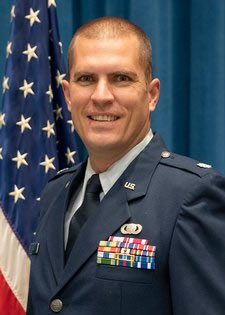
Lt. Col. David Curtis retires from AFIT after 20 years of dedicated service to the USAF. (U.S. Air Force photo)
As an assistant professor of astronautical engineering,
Curtis's primary teaching focus was in the field of control theory. His
research centered on spacecraft rendezvous and proximity operations (RPO),
while also guiding students in projects related to space situational awareness,
guidance algorithms, and automated aerial refueling.
When asked about advice for new officers and faculty, Curtis
offered practical wisdom.
“For new officers, my advice would be to do the best you can
at the job you have, and the rest will work itself out.”
He emphasized student-centeredness for the new faculty,
suggesting, “the focus should be on the students. Focus on doing research that
the students are interested in [pursuing] and that someone cares about.”
For new students, he highlighted the importance of work-life
structure.
“AFIT has a lot of flexibility, which is a good thing, but
it can also be a bad thing as well. Set up a routine for your studies that
resembles what would be required for a job, then hold yourself to it. Simply
picking your ‘work’ hours and sticking to them can be helpful.”
Reflecting on his Air Force career, Curtis identified his
deployment to Afghanistan in 2009-2010 as a particularly valuable
experience.
“I’m not sure I would say I ‘enjoyed’ it, but it was
certainly a valuable experience. Seek out a deployment early in your career if
you can, since it’s a good thing to have completed.”
After retirement, Curtis will remain in the Dayton area,
continuing to contribute his expertise as a contractor working for the Air
Force research Lab (AFRL).
Lt. Col. David Curtis's dedication to his students and his commitment to technical excellence have made him a valued member of the AFIT community. The Institution thanks him for his 20 years of service and wishes him well in his future endeavors.
AFIT’s GSEM provides in-residence and distance learning graduate degrees and certificates in engineering, applied science, mathematics and management. GSEM provides its students with several significant advantages, including a more personalized educational experience; academic programs with a defense-related focus, and research on high-priority defense problems.
About AFIT
AFIT is located at Wright-Patterson AFB, Ohio. AFIT’s mission is to educate
defense professionals to innovatively accomplish the deterrence and warfighting
missions of the USAF and USSF. AFIT’s vision is to lead defense-focused
education, research and consultation to accelerate military superiority across
all domains and is accomplished through operationally relevant advanced
academic education, research, and professional continuing education. For more
information, please visit the AFIT webpage https://www.afit.edu/ or contact EN outreach, AFIT.EN.Outreach@us.af.mil.