AFIT Chapter of American Nuclear Society Organizes Informational Student Trip
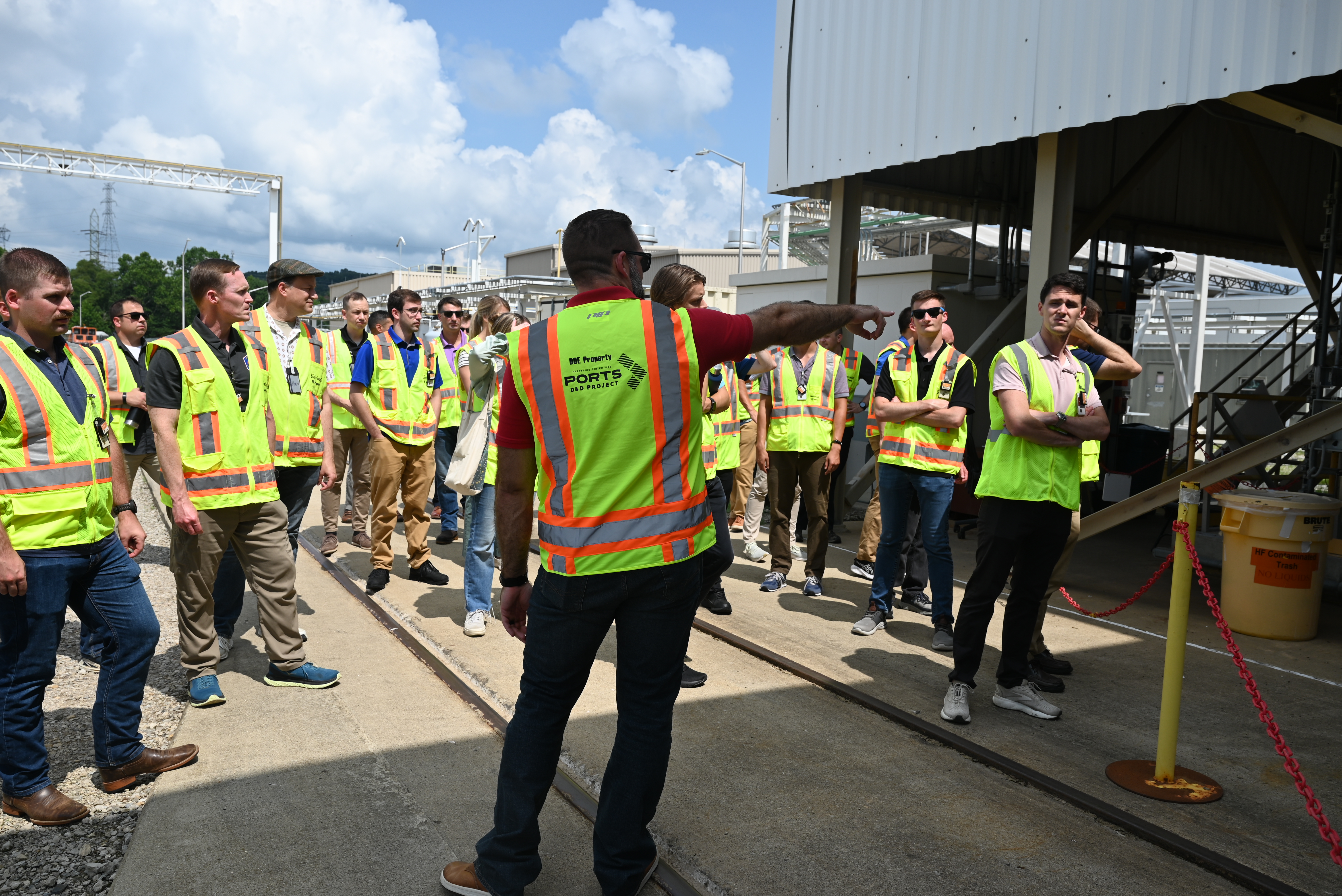
Zak Lafontaine, depleted uranium hexafluoride (DUF6) program manager, explaining the process of converting uranium hexafluoride to uranium oxide at the at the DUF6 conversion facility located at the Department of Energy’s Portsmouth Gaseous Diffusion Plant. (U.S. Air Force contributed photo)
The AFIT student chapter of the American Nuclear Society
(ANS) organized a field trip to visit the Department of Energy (DOE) Portsmouth
Site and the American Centrifuge Plant, operated by Centrus, near Piketon,
Ohio. The trip was open to all AFIT students, faculty, and contractors, and a
total of 31 participants attended, including members of the AFIT ANS chapter
and students enrolled in various nuclear engineering courses.
As part of Air University’s broader mission to educate and
develop joint warfighters, AFIT provides advanced academic education and
research that prepares officers, enlisted members, civilians and international
partners to apply technical expertise in real-world operational environments,
supporting more informed and effective decision-making.
The group’s first stop was at the Portsmouth Gaseous
Diffusion Plant, originally constructed by the United States Atomic Energy
Commission to provide enriched uranium for the nation’s nuclear defense system
and later for use in commercial nuclear power reactors. The visit began with an
overview and history of the Portsmouth Site, presented by Jeremy Davis, the
site lead, and Zak Lafontaine, the depleted uranium hexafluoride (DUF6) program
manager. The Portsmouth site’s plant operated from 1952 to 2001 and produced
enriched uranium for national security applications, U.S. Navy ship and
submarine propulsion, and civilian power plants.
Following the overview, the students and faculty were taken
on a tour of the 3,700-acre site. They observed the DOE’s ongoing
decontamination and decommissioning program. This program involves the
demolition and disposal of approximately 415 facilities.
The tour included stops at the X-300 Plant Control Facility,
the on-site waste disposal facility (OSWDF), and the DUF6 conversion facility.
The OSWDF has been engineered to ensure the safe containment of contaminated
debris from the demolition of process buildings and other hazardous materials
from the site. At the DUF6 conversion facility, the DOE’s inventory of over
16,000 cylinders, containing more than 198,000 metric tons of DUF6, is
converted into a more stable uranium oxide form. This form is used for reuse,
storage, transportation, and disposition.
In the afternoon, the students toured the Centrus American
Centrifuge Plant. The plant began uranium enrichment operations in 2023 and
currently produces High-Assay, Low-Enriched Uranium (HALEU) for the DOE.
Looking ahead, Centrus plans to expand its operations at the site by adding
thousands of additional centrifuges at its American Centrifuge Plant to deliver
large-scale production of both LEU and HALEU.
“The field trip was a fascinating look at the past and
present of uranium enrichment and waste management and provided critical
insight into a portion of the nuclear fuel cycle, which is a core class for all
nuclear engineering students at AFIT,” said LTC Aaron Ferguson, AFIT Nuclear
Engineering Program instructor of neutral particle transport and the physics of
nuclear explosives.
“Seeing first-hand the technologies and processes for
uranium enrichment, as well as the immense size of the facilities, enables an
appreciation for the sheer scale of the DOE Nuclear Enterprise, which continues
to ensure a safe, secure, and reliable nuclear stockpile critical to strategic
deterrence.”
The AFIT Nuclear Engineering Program is critical to the
Department of War (DoW) and the Department of the Air Force (DAF) as it
educates defense professionals to innovatively support the Air Force and Space
Force’s deterrence and warfighting missions, aiming to achieve technological
superiority for the DoW.
AFIT graduates are often called upon to serve in leadership
roles across a variety of DoW and DAF initiatives. Many of them continue their
careers in the U.S. Air Force or other military branches, as well as with
defense contractors and national laboratories.
“Previous AFIT nuclear engineering alumni have gone on to work in organizations such as the National Nuclear Security Administration (NNSA), U.S. Strategic Command, and at various national laboratories, where they play key roles in ensuring the safety and reliability of the nation’s nuclear deterrent and energy security. This field trip helped reinforce the relevance of these careers, as students saw firsthand the technologies and policies that these alumni might engage with in their professional futures,” said LTC Ferguson.
About AFIT
AFIT’s Graduate School of Engineering and Management (GSEM)
provides in-residence and distance learning graduate degrees and certificates
in engineering, applied science, mathematics and management. GSEM provides its
students with several significant advantages: a more personalized educational
experience, academic programs with a defense-related focus, and research on
high-priority defense problems.
AFIT is located at Wright-Patterson AFB, Ohio. AFIT’s
mission is to educate defense professionals to innovatively accomplish the
deterrence and warfighting missions of the USAF and USSF. AFIT’s vision is to
lead defense-focused education, research and consultation to accelerate
military superiority across all domains and is accomplished through
operationally relevant advanced academic education, research, and professional
continuing education. For more information, please visit the AFIT webpage https://www.afit.edu/ or contact GSEM
outreach at AFIT.EN.Outreach@us.af.mil.