From Blueprint to Launchpad: 1st Lt. Matthew Evans' Impact on the U.S. Space Force Mission
By Christy Bui
Air Force Institute of Technology
The U.S. Space Force (USSF) is powered by a team of highly
skilled guardians, experts dedicated to securing the nation's interests in
space. 1st Lt. Matthew Evans is one such expert, still early in his career,
whose service as an engineer is already marked by significant contributions to
both future space architecture and current launch capabilities.
A 2024 graduate of the Air Force Institute of Technology
(AFIT), Lt. Evans completed a rigorous academic program in aeronautical engineering
with an emphasis in spacecraft design and test, as well as finite element
modeling. This academic foundation enabled him to develop a groundbreaking,
now-patented design for a large-scale, 27-unit (27U) CubeSat chassis (where
every “unit” measures 10 cm x 10 cm x 10 cm).
As part of Air University’s broader mission to educate and
develop joint warfighters, AFIT provides advanced academic education and
research that prepares officers, enlisted members, civilians and international
partners to apply technical expertise in real-world operational environments,
supporting more informed and effective decision-making.
“This innovative concept introduces a modular and highly
adaptable platform, designed to enhance mission flexibility and operational
resiliency for space assets. By addressing critical capability gaps,
particularly for satellites in higher orbits, this work represents a meaningful
step toward more cost-effective small satellite structures and missions,” said
Lt. Evans.
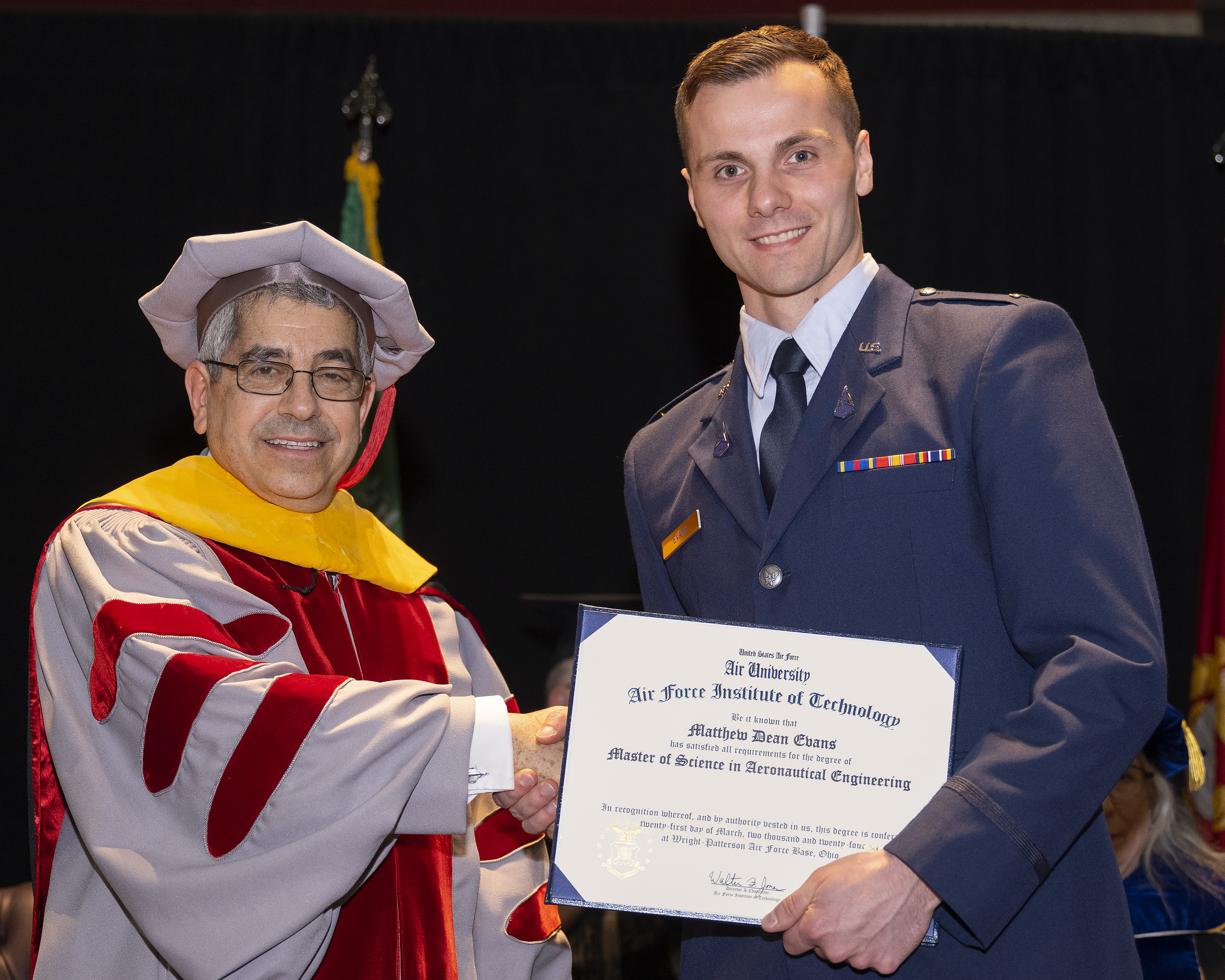
1st Lt. Matthew Evans
received a master’s degree in aeronautical engineering from AFIT in 2024. (U.S.
Air Force photo)
Following his graduation from AFIT, Lt. Evans assumed a critical role as a propulsion responsible engineer within the Vulcan Centaur program office. He was entrusted with engineering oversight for the Graphite Epoxy Motor (GEM) 63XL, a solid rocket motor that provides the Vulcan Centaur launch vehicle with an enhanced payload capability.
In this capacity, his responsibilities are comprehensive,
spanning programmatic management and direct operational support. He is tasked
with identifying and mitigating technical risks, then presenting his findings
to senior leadership to inform critical decisions. A key aspect of his mission
assurance duties involves traveling to hardware suppliers for firsthand
assessments, ensuring each component meets stringent flightworthiness
standards. During launch campaigns, he serves on-console, monitoring telemetry
and providing real-time analysis to navigate challenges as they arise, ensuring
mission success.
His impact on the USSF mission is already substantial. Lt.
Evans was a key contributor to the certification of a new National Security
Space Launch vehicle, has provided engineering support for three successful
launch campaigns, and has assessed the flightworthiness of no less than 10
solid rocket motors in less than 24 months since he graduated from AFIT.
Notably, he played an instrumental role in the resolution of a major technical
risk, demonstrating exceptional expertise and leadership under pressure.
As the operational tempo for national security launches continues to increase, Lt. Evans's role remains crucial. He is a testament to the talent and dedication that will define the next chapter of the USSF, ensuring America’s continued leadership in the space domain.
ABOUT AFIT
AFIT’s Graduate School of Engineering and Management (GSEM)
provides in-residence and distance learning graduate degrees and certificates
in engineering, applied science, mathematics and management. GSEM provides its
students with several significant advantages: a more personalized educational
experience, academic programs with a defense-related focus, and research on
high-priority defense problems.
AFIT is located at Wright-Patterson AFB, Ohio. AFIT’s
mission is to educate defense professionals to innovatively accomplish the
deterrence and warfighting missions of the USAF and USSF. AFIT’s vision is to
lead defense-focused education, research and consultation to accelerate
military superiority across all domains and is accomplished through
operationally relevant advanced academic education, research, and professional
continuing education. For more information, please visit the AFIT webpage https://www.afit.edu/ or contact GSEM
outreach at AFIT.EN.Outreach@us.af.mil.