CLPPRS: Building the DOW’s Next Testbed for Survivability
By Department of Engineering Physics Faculty
Air Force Institute of Technology
The Air Force Institute of Technology (AFIT) remains at the forefront of education and research, directly strengthening our national defense. A new initiative, the Combined Laser and Pulsed Power Radiation Source (CLPPRS), exemplifies AFIT’s role in tackling some of the most pressing challenges facing the Department of War (DOW).
Why CLPPRS Matters
As the United States modernizes its nuclear deterrent, it must also ensure that critical systems can survive and operate in extreme radiation environments. Today, options for testing under those conditions are limited. Small-scale laboratories cannot provide representative exposures, while large national-level facilities are costly, oversubscribed, and difficult to access on program-relevant timelines. The consequence is that many systems face the risk of late or incomplete survivability testing.
CLPPRS fills this critical gap. By developing a DOW-owned, mid-scale testbed at Wright-Patterson Air Force Base, AFIT will provide a cost-effective, on-demand environment for radiation survivability testing. The system will deliver neutron, x-ray, gamma, and charged-particle radiation, single or in combination, within a single target chamber. This capability directly supports survivability needs across strategic systems, aircraft, and space assets.
A Combined Approach
The CLPPRS concept integrates two complementary technologies:
- High-repetition-rate lasers impacting liquid targets capable of producing neutrons, x-rays, and energetic particles at rapid shot rates, enabling fast datasets and tunable exposures.
- Compact pulsed-power drivers that generate high-energy, high-fluence electrons, ions, and additional x-rays depending on diode configuration.
By synchronizing these two sources in a single chamber, CLPPRS will create mixed-radiation environments that more accurately reflect real-world threats than any single source can achieve.
Benefits Beyond Testing
CLPPRS is not just about hardware; it is also about people. Each year, the initiative is planned to train more than 20 students, interns, and researchers in radiation effects and survivability testing. AFIT already provides the nation’s only graduate curriculum on nuclear weapon effects; CLPPRS strengthens this foundation and ensures a pipeline of experts prepared to lead in critical mission areas.
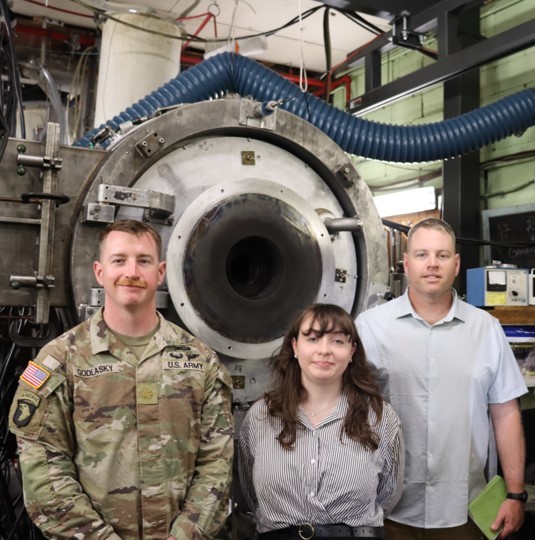
The effort is led by AFIT Department of Engineering Physics Assistant Professor and Deputy Department Head Lt. Col. Jesse Foster, who serves as project director. Program execution is planned to align with DOW test and evaluation priorities, ensuring the capability directly supports department-wide needs. This alignment underscores the significance of CLPPRS not only at AFIT but also to the broader defense enterprise.
CLPPRS also positions AFIT as a hub for collaboration across the DOW and the Department of Energy (DOE), ensuring research relevance while advancing AFIT’s educational mission.
Faster, Cheaper, Better
Compared to national facilities that cost hundreds of thousands of dollars per shot, CLPPRS offers a more affordable and flexible option. Lasers can fire thousands of times per second at a cost of just a few dollars per minute, while pulsed-power systems can operate multiple times per day. This dramatically reduces costs and accelerates testing, enabling programs to identify issues earlier in development and reduce risk before high-stakes national campaigns.
Looking Ahead
Phase 0 of CLPPRS is being planned to mature designs, reduce integration risk, and demonstrate initial radiation outputs within a proposed 2-year, $4M effort. Recent progress includes securing 8,000 square feet of space, where the laser system shown in Fig. 1 is already operational under the leadership of AFIT Professor of Physics, Dr. Anil Patnaik. This milestone provides both a physical foundation and a technical springboard for the larger combined capability.
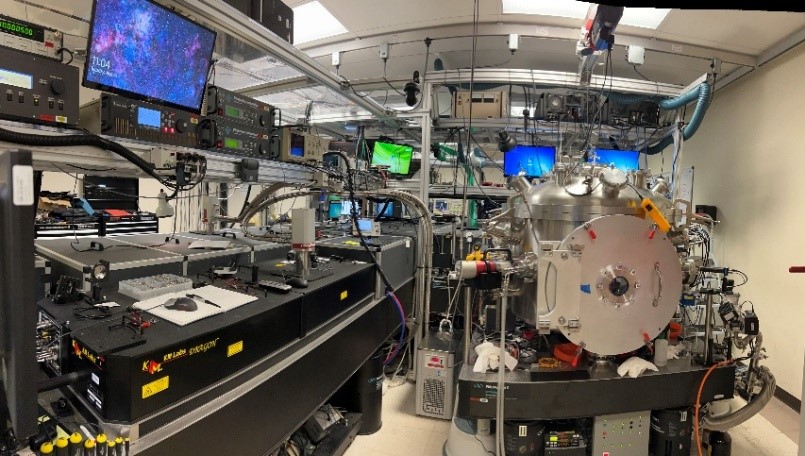
(U.S. Air Force contributed photo)
The effort is also drawing on AFIT’s pulsed-power expertise. Lessons learned from prior experimental campaigns conducted by Lt. Col. Foster and his students are directly informing the design and integration of CLPPRS. These projects not only advance science but also prepare AFIT graduate students to apply rare survivability skills in the field.
With sustained support, CLPPRS will become a cornerstone of DOW survivability testing by the early 2030s, providing both a world-class research platform and a training ground for the next generation of nuclear effects experts. As AFIT develops CLPPRS, it reaffirms its mission: to advance technology, educate leaders, and deliver solutions that keep our systems resilient, ensuring they remain “never doubted, always feared.”
For more information about AFIT’s Department of Engineering Physics and its graduate degree programs, please visit https://www.AFIT.edu/ENP/.
AFIT’s Graduate School of Engineering and Management (GSEM) provides in-residence and distance learning graduate degrees and certificates in engineering, applied science, mathematics and management. GSEM provides its students with several significant advantages, including a more personalized educational experience, academic programs with a defense-related focus, and research on high-priority defense problems.
About AFIT
AFIT is located at Wright-Patterson AFB, Ohio. AFIT’s mission is to educate defense professionals to innovatively accomplish the deterrence and warfighting missions of the USAF and USSF. AFIT’s vision is to lead defense-focused education, research and consultation to accelerate military superiority across all domains and is accomplished through operationally relevant advanced academic education, research, and professional continuing education. For more information, please visit the AFIT webpage https://www.afit.edu/.