AFIT CI Student Showcases Civil Engineer Research to Distinguished Military Leaders
By Jaclyn Knapp
Posted Friday, February 13, 2026
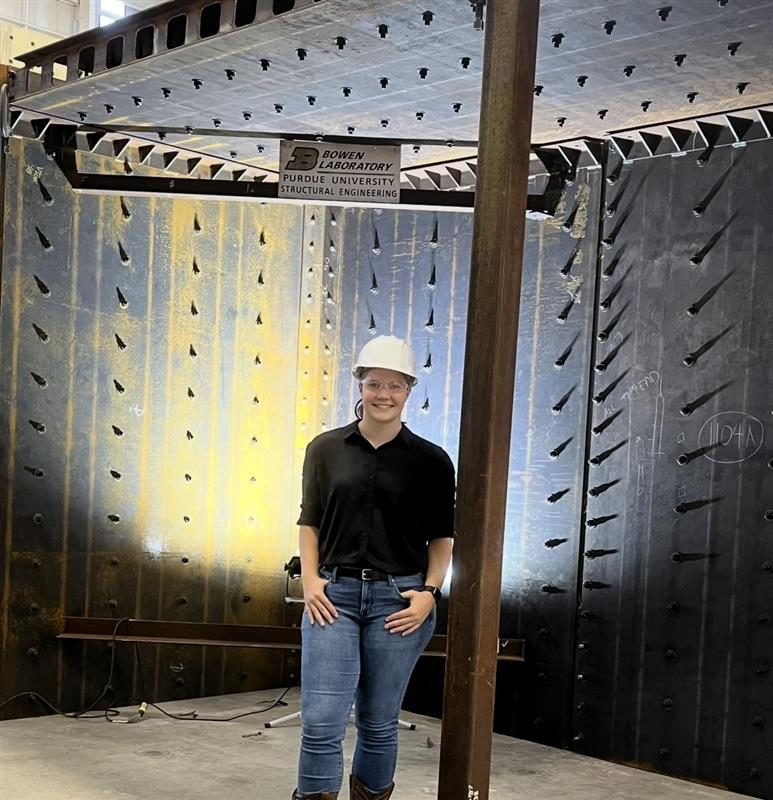
In 2025, Air
Force Institute of Technology’s Civilian Institution student, 2nd Lt. Sydney
Davis and her research team at Purdue University, demonstrated the benefits of
using steel plate composite (SC) structures for increased protection of Air
Force military and civilian assets to distinguished military leaders.
Lt. Davis
is researching the performance of SC structures subjected to
large blast loads. SC walls are
extremely effective at handling large blast loads and increase protection to structures
such as nuclear reactors, protective structures and weapons launch and test
facilities.
Additionally,
SC walls are more cost effective and efficient to build than reinforced
concrete structures that are currently in use.
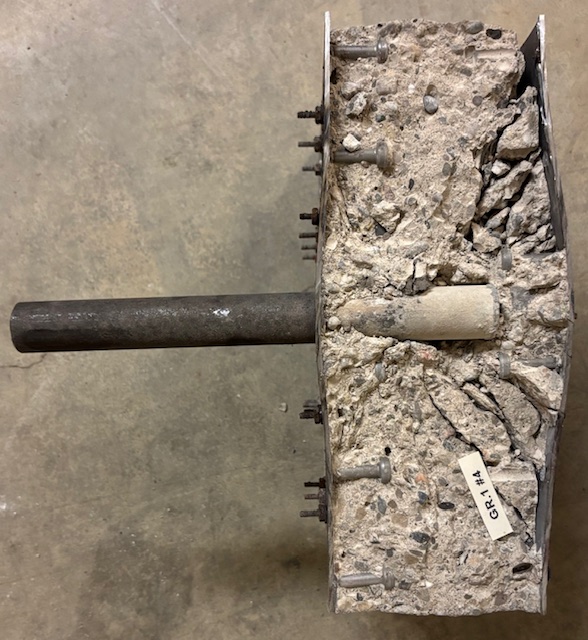
For each
visit, Lt. Davis presented her research on the missile impact response and
performance capability of SC walls and their efficiency in preventing
perforation of shrapnel and other large projectiles.
The Air
Force Institute of Technology’s Civilian Institution student, 2d Lt. Sydney
Davis is completing her Master of Science in Civil & Construction Engineering
at Purdue University. In 2025, Lt.
Sydney Davis and her research team demonstrated the benefits of using steel
plate composite (SC) structures to increase protection of the Air Force’s
military and civilian assets to distinguished military leaders. (Courtesy photo by Purdue University)
“The distinguished
military leaders received the research very well and with great excitement to
support continued research and future applications of SC structures across the
Department of War (DoW).
These
visits showcased the active cooperation between US military officers and the
civilian and academic workforce to continue to advance DoW capabilities,"
said Davis.
Lt. Davis obtained
her Bachelor of Science in Civil Engineering from the United States Air Force
Academy (USAFA) in May 2024 and commissioned into active duty as a 32E Civil
Engineer after graduation.
She is
currently completing her Master of Science in Civil & Construction Engineering
at Purdue University’s Lyles School of Civil and Construction Engineering and
is part of a research group under the Purdue Applied Research Institute (PARI)
Infrastructure and Innovation Lab.
“Within
CE, my MS degree specializes in structural engineering, which allows me to gain
more knowledge related to why I chose to study CE: I enjoy building design and appreciate how
civil engineers support nearly every other field by providing the specific
infrastructure they need.
It is a
very diverse field of engineering because no structure services the exact same
needs, leading to an infinite number of project scopes and unique design
opportunities,” said Davis.
Since Lt.
Davis is pursuing a technical degree that is not directly offered by AFIT, she
was approved to pursue a degree through AFIT’s CI Program and chose to attend
Purdue University based on their Purdue Military Research Institute (PMRI).
“The
partnership between AFIT and our civilian universities, hospitals, industries
and other institutions is a force multiplier for our students and the Air and
Space Forces.
We get
access to world class professionals and state-of-the-art equipment that allows
our amazing students to keep the Department of the Air Force at the leading
edge of technology that enhances our warfighting capabilities,” said Col.
Walter Lesinski, director, Civilian Institution Programs.
AFIT CI is
responsible for placing selected Air Force officers, enlisted members, and
civilians at accredited civilian universities, hospitals and leading industries
to pursue advanced degrees and programs.
For more
information about AFIT’s CI Program, please contact: AFIT.CIWorkflow@us.af.mil
or visit www.afit.edu/CIP
About
AFIT
AFIT is
located at Wright-Patterson AFB, Dayton, Ohio. AFIT’s mission is to
educate defense professionals to innovatively accomplish the deterrence and
warfighting missions of the USAF and USSF.
AFIT’s
vision is to lead defense-focused education, research and consultation to
accelerate military superiority across all domains and is accomplished through
operationally relevant advanced academic education, research, and professional
continuing education.
For more
information, please visit the AFIT webpage https://www.afit.edu/