Looking for Dark Lightning: Airborne Detectors for Thunderstorm Radiation Searches
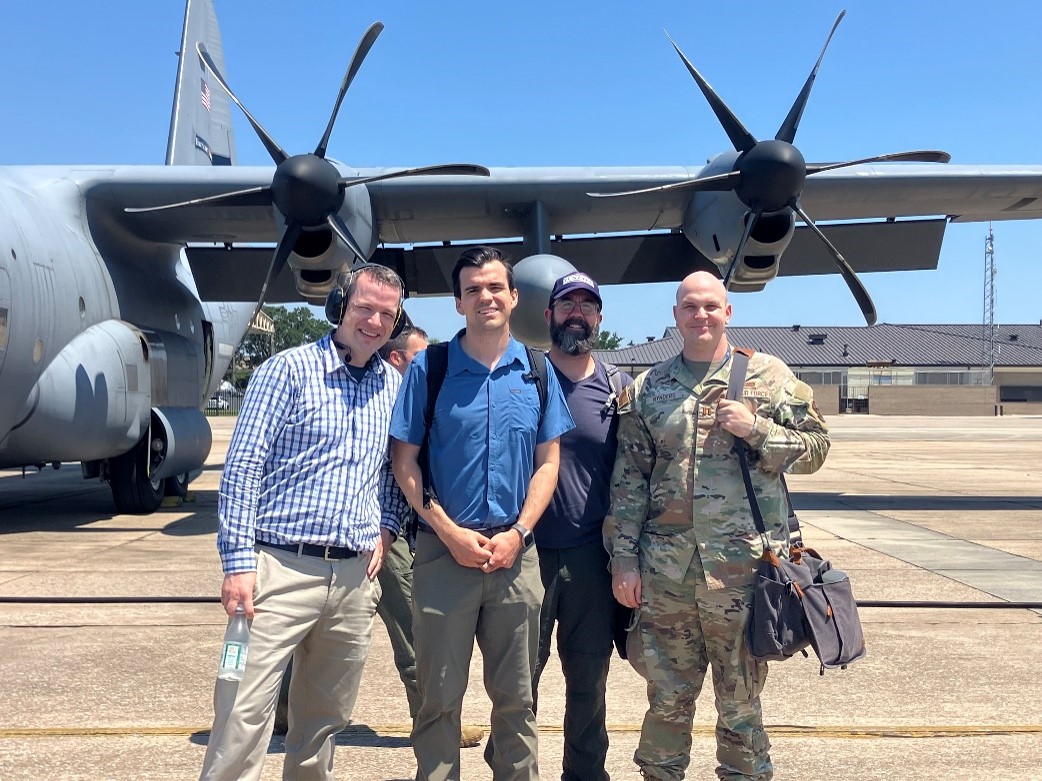
Members of the HERA team preparing for detector installation aboard a Hurricane Hunter aircraft at Keesler AFB in Aug. 2025. Pictured from left: Dr. Will Erwin (711 HPW),
Dr. Juan Manfredi (assistant professor, AFIT Department of Engineering Physics and NEAT Center), Dr. Jeff Chaffin (postdoctoral scholar, AFIT Department of Engineering Physics and NEAT Center) and Capt. Michael Rynders (Ph.D. student, AFIT Department of Engineering Physics). (U.S. Air Force photo)
By Juan J. Manfredi Jr.
Air Force Institute of Technology
Lightning has been the object of scientific study ever since Benjamin Franklin first flew his famous kite. Despite the long history of this research, lightning continues to hold surprises for scientists. One example is the terrestrial gamma flash (TGF), also known as “dark lightning”, which refers to the massive but mysterious burst of energetic photon radiation released by 1-2% of lightning flashes. TGFs present an unknown occupational risk to Air Force personnel.
Most aircraft generally avoid thunderstorms, which mitigates the possible negative health effects from TGF radiation. The notable exception to this rule is the WC-130J “Hurricane Hunter” aircraft flown by the 53rd Weather Reconnaissance Squadron (53rd WRS) at Keesler AFB in Mississippi. Hurricane Hunters fly directly into active storm systems, meaning that they could receive an above-normal radiation dose if a TGF occurs in proximity to the aircraft.
“The 53 WRS’s unique mission of intentionally flying into the worst kind of weather makes our WC-130J the ideal platform for this study. The health and safety of our aircrews is paramount, so we are proud to participate in this collaboration with AFIT that helps us better understand risks in the operational environment, like TGFs, while also contributing to vital scientific research,” said Lt. Col. Jeremy DeHart, Aerial Reconnaissance Weather Officer, 53rd Weather Reconnaissance Squadron.
A recent project led by the 711th Human Performance Wing (711 HPW) in collaboration with AFIT and the 53rd WRS seeks to understand the potential risk of TGFs to Hurricane Hunter aircrew while also investigating the fundamental science of TGFs.
AFIT led the design, construction, and testing of the High Elevation Radiation Array (HERA), a set of 10 self-contained radiation detection equipment boxes that each include a sodium iodide scintillator detector, a plastic scintillator detector, a GPS module, and a data acquisition system.
In August 2025, the project team installed HERA units aboard all 10 Hurricane Hunter aircraft (see photo). With the support of the 53rd WRS, the team tested the equipment during a test flight to check system performance at altitude. Data have been recorded across several storm flights already and primary data collection will take place over the 2026 hurricane season.
ABOUT AFIT
AFIT’s Graduate School of Engineering and Management (GSEM) provides in-residence and distance learning graduate degrees and certificates in engineering, applied science, mathematics and management. GSEM provides its students with several significant advantages: a more personalized educational experience, academic programs with a defense-related focus, and research on high-priority defense problems.
AFIT is located at Wright-Patterson AFB, Ohio. AFIT’s mission is to educate defense professionals to innovatively accomplish the deterrence and warfighting missions of the USAF and USSF. AFIT’s vision is to lead defense-focused education, research and consultation to accelerate military superiority across all domains and is accomplished through operationally relevant advanced academic education, research, and professional continuing education. For more information, please visit the AFIT webpage https://www.AFIT.edu/ or contact GSEM outreach at AFIT.EN.Outreach@us.af.mil.