AFIT’s CDE Conducts Optical Turbulence Research
By Dr. Melissa Beason
Air Force Institute of Technology
The Air Force Institute of Technology’s Center for Directed Energy (AFIT CDE) is researching the impact of atmospheric effects, such as absorption, scattering, and optical turbulence on directed energy (DE) operations.
Of these potentially deleterious effects, optical turbulence generally has the greatest impact on a DE device like a High Energy Laser (HEL). Random pockets of hot and cold air result in minute random fluctuations in the refractive index known as optical turbulence. These fluctuations randomly bend light rays that pass through it causing effects like the twinkle of stars.
Optical turbulence impacts a laser by causing it to wander off a target and to increase the focused spot size; both of which impact effectiveness against adversarial targets as shown in figures 1 and 2. AFIT’s optical turbulence research will support deployment and enhance laser propagation models to provide weapon effectiveness information for battlefield managers.
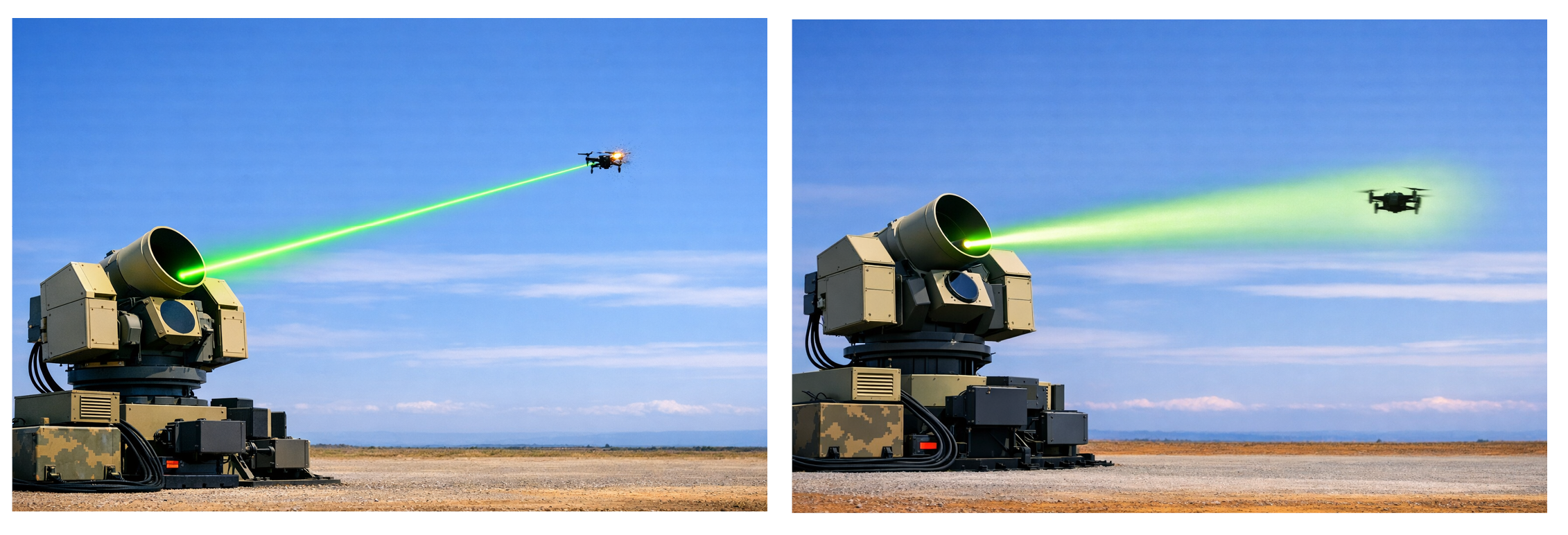
Figures 1-2. AFIT’s CDE is studying the impact of atmospheric effects, such as absorption, scattering, and optical turbulence to understand why it is critical for successful directed energy operations. On the left (figure 1), during periods of low optical turbulence, a High Energy Laser (HEL) can effectively focus to a small spot with sufficient power density to destroy or disable a target. In figure 2 (right), a HEL is unable to maintain focus on a tight spot on a target as turbulence strength increases and turbulence induces beam spread and wander. (U.S. Air Force contributed photos)
While it is possible to reduce these effects in some cases when using adaptive optics (AO), it remains critical to understand the impact of turbulence to optimize and understand the limitations of AO corrections. Additionally, many systems aren’t equipped with AO compensation.
It is especially important to understand the behavior of turbulence and the resulting effects near the surface since the platform for most laser systems are at convenient ground locations.
AFIT CDE is actively researching surface layer turbulence and using beam propagation models to understand how changes in turbulence statistics impact DE. Turbulence strength is greatest near the ground and tends to drop with height. Theoretical models that are used to estimate this drop in turbulence, or lapse rate, can vary significantly from what is measured. AFIT CDE is studying the physical parameters that drive how turbulence strength lapses with altitude using a combination of data available from large field campaigns and ongoing research at the AFIT range.
During the summer of 2026, AFIT students and faculty began an extensive field campaign to measure optical turbulence strength as a function of height utilizing 5-levels of ultrasonic anemometers to provide a point measurement of turbulence strength (figure 3). A scanning turbulence profiler (MATS), developed by MZA Associates Corporation provided turbulence profiles along multiple slant paths, and SOund Detection And Ranging (SODAR) used acoustic pulses to profile turbulence up to an estimated 250 meters.
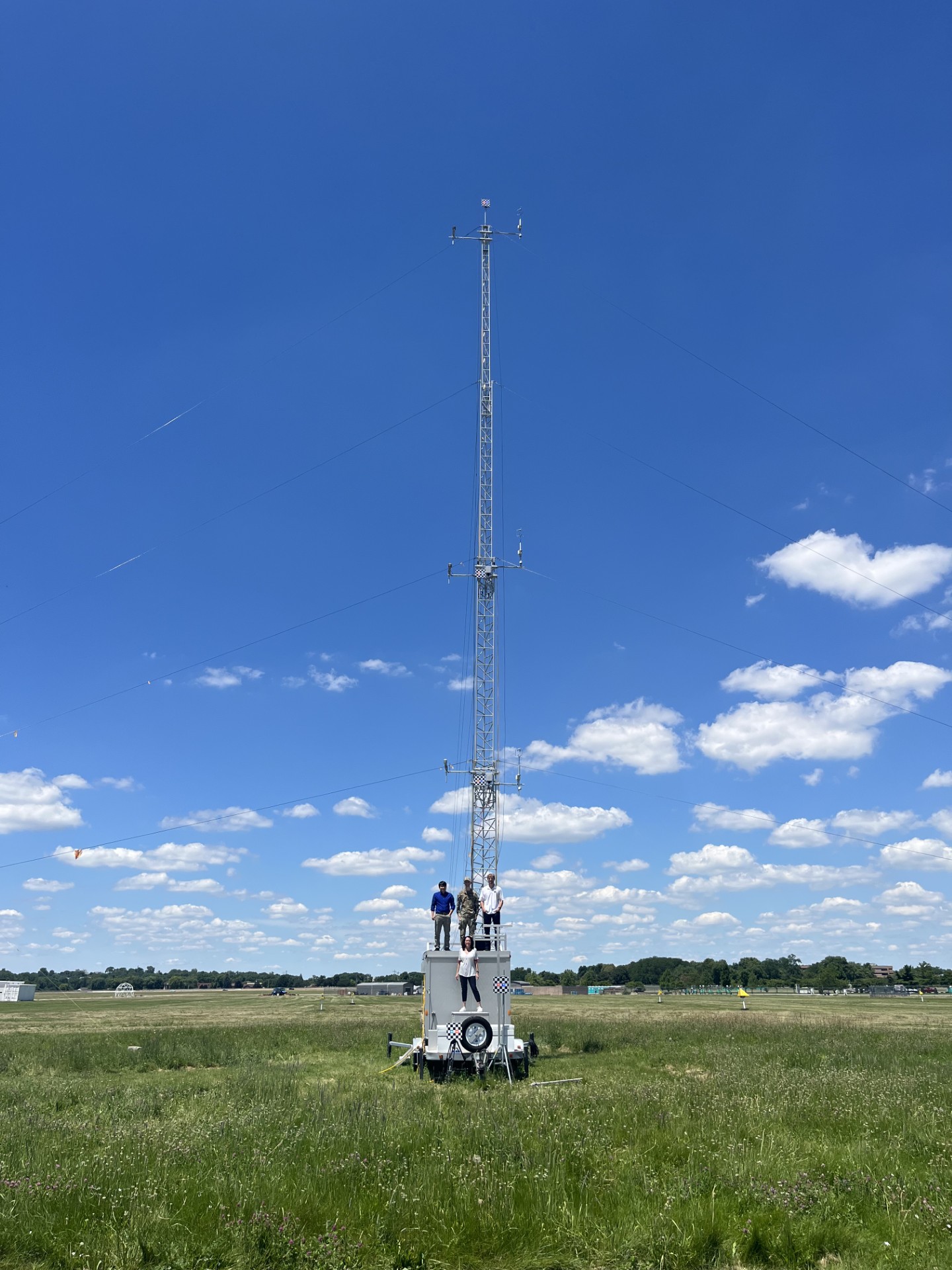
Figure 3. Students, faculty and staff from AFIT’s CDE pose in front of the 30-m turbulence characterization mast that measures turbulence strength. Pictured from left to right are An Bui, U.S. Air Force 2d Lt. JP Stolle, Caden Bistrek and Dr. Melissa Beason. (U.S. Air Force contributed photo)
Measurements from the various modalities will be stitched together to provide a complete turbulence profile from 2m – 250m and correlated with thermodynamic and surface characteristics to gain understanding into primary drivers of turbulence lapse rate. The long-term goal of this project is to estimate near-surface turbulence lapses based on simple location specific measurements. Using this information with propagation models will improve surface layer engagement estimates.
AFIT CDE is also investigating the impact of high aerosol events such as wildfires or battlefields on optical turbulence. During the summer of 2023, Wright-Patterson AFB experienced haziness due to smoke from Canadian wildfires. The smoke reduced solar radiation reaching the earth’s surface and resulted in reduced optical turbulence strength.
Figures 4 and 5 contrast images when haze from the smoke is visible on June 28, 2023, and the day after aerosols from the smoke were depleted by rain on June 30, 2023.
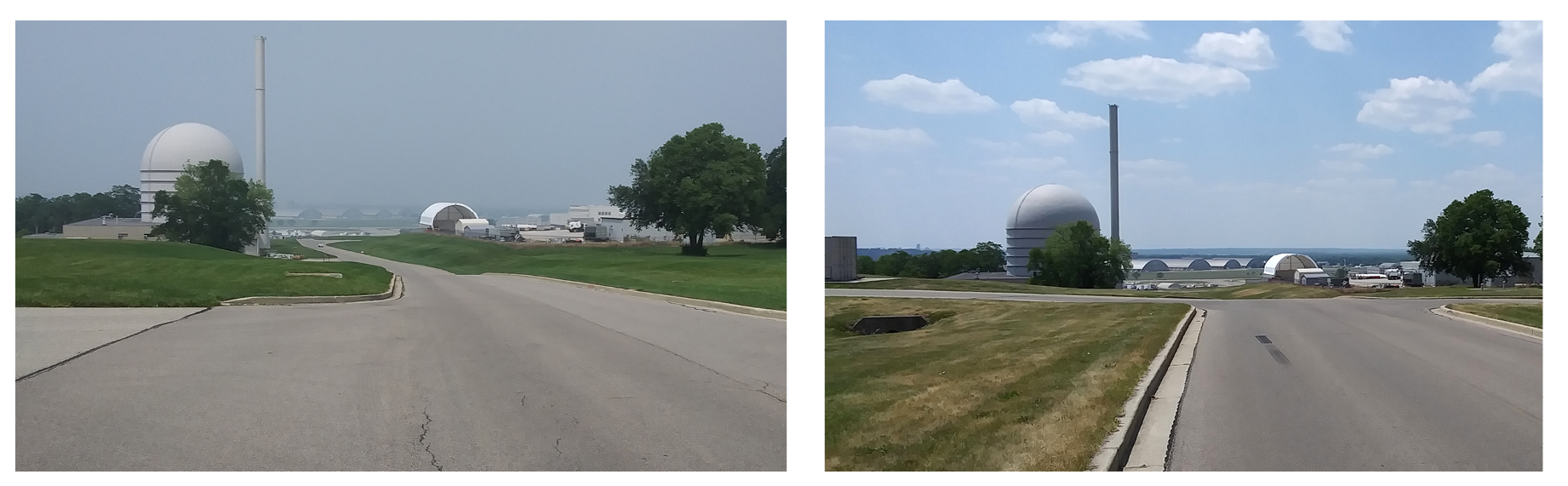 Figures 4-5. In the left photo, taken near the AFIT range at Wright-Patterson AFB, Ohio, haze is visible due to smoke from Canadian wildfires on June 28, 2023. In the right photo, clear skies are visible in the same location after rain depleted airborne aerosols from Canadian wildfires on June 30, 2023.(U.S. Air Force contributed photos)
Figure 6 shows solar radiation and optical turbulence strength (Cn2) measured on the AFIT range during this time. The top graphs show uninterrupted solar irradiance and optical turbulence measured on June 2, 2023, prior to the onset of the Canadian smoke. In contrast, the bottom graphs show the solar irradiance during the peak of the smoke event and the resulting optical turbulence on June 27, 2023.
Lower optical turbulence implies less impact on DE, however, the higher aerosol concentration resulting from the smoke results in lower optical power transmission. CDE is seeking to understand this tradeoff, as well as other changes in turbulence that results from high aerosol concentrations.
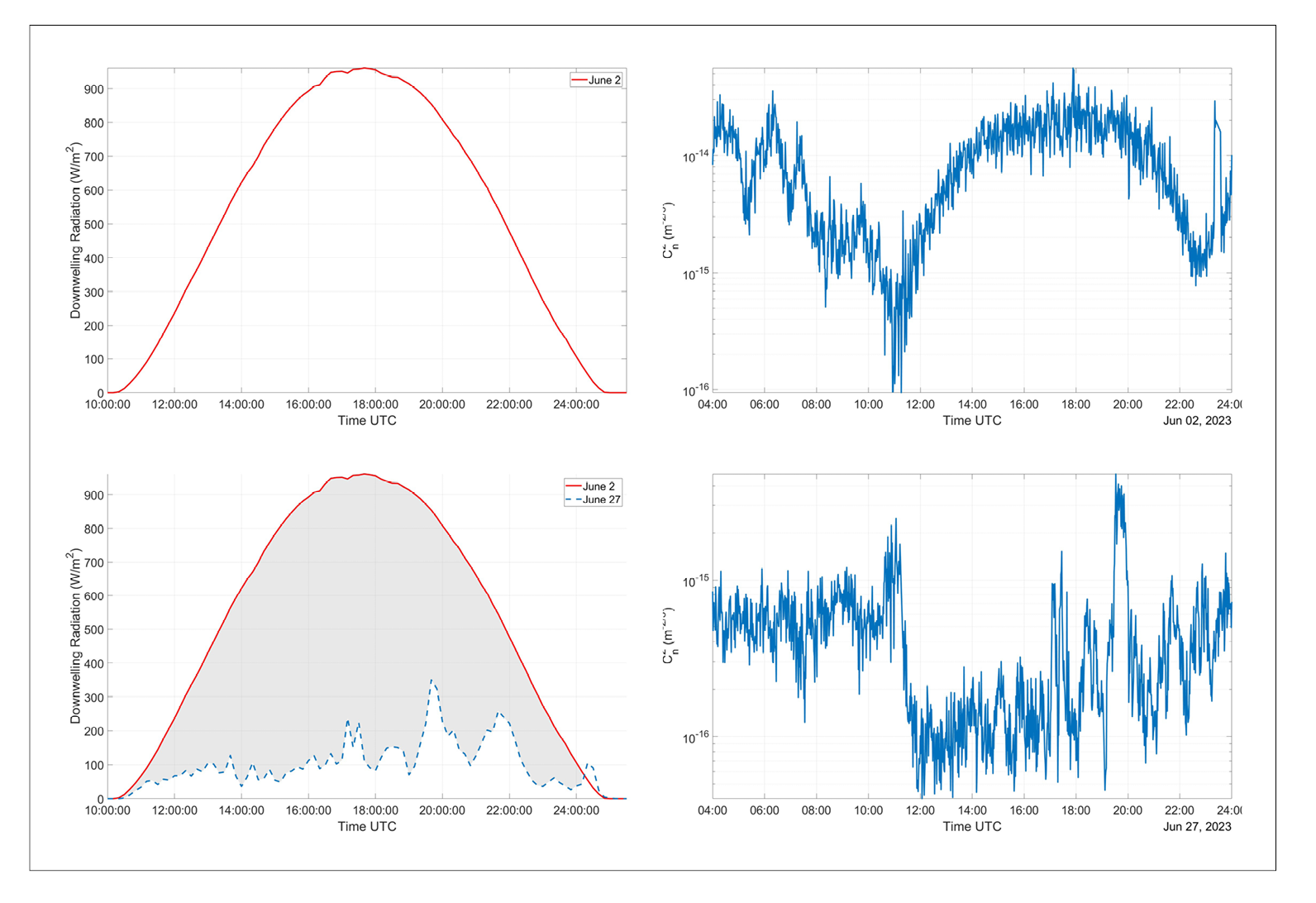 Figure 6. Data from AFIT CDE’s investigation into the impact of high aerosol events, such as wildfires or battlefields, on optical turbulence. The data compares downwelling radiation prior to a Canadian wildfire smoke event on June 2, 2023, and during peak aerosol loading on June 27, 2023. Both graphs on the right side show corresponding optical turbulence strength (Cn2) for June 2, 2023, and June 27, 2023. (U.S. Air Force contributed image)
ABOUT AFIT
AFIT’s Graduate School of Engineering and Management (GSEM) provides in-residence and distance learning graduate degrees and certificates in engineering, applied science, mathematics and management. GSEM provides its students with several significant advantages: a more personalized educational experience, academic programs with a defense-related focus, and research on high-priority defense problems.
AFIT is located at Wright-Patterson AFB, Ohio. AFIT’s mission is to educate defense professionals to innovatively accomplish the deterrence and warfighting missions of the USAF and USSF. AFIT’s vision is to lead defense-focused education, research and consultation to accelerate military superiority across all domains and is accomplished through operationally relevant advanced academic education, research, and professional continuing education. For more information, please visit the AFIT webpage https://www.AFIT.edu/ or contact GSEM outreach at AFIT.EN.Outreach@us.af.mil.