AFIT Research on Fuel Trimming Reveals Substantial Savings for U.S. Air Force
Members of the Air Force Institute of Technology’s (AFIT)
Department of Operational Sciences recently published research exploring a
novel approach to reducing drag and improving fuel efficiency in the C-17A
through “fuel trimming,” a method strategically utilizing onboard fuel
management.
The C-17A is pivotal
in Air Mobility Command’s (AMC) mobility portfolio for the United States and
eight other countries. Its versatility and operational capacity consistently
wield vital movement, with a daily average of nearly 70 tails scattered
globally by AMC alone.
Despite its importance to the Air Force, the C-17A
Globemaster III’s operational efficiency is under constant scrutiny due to the
current fiscally conscious and environmentally aware climate.
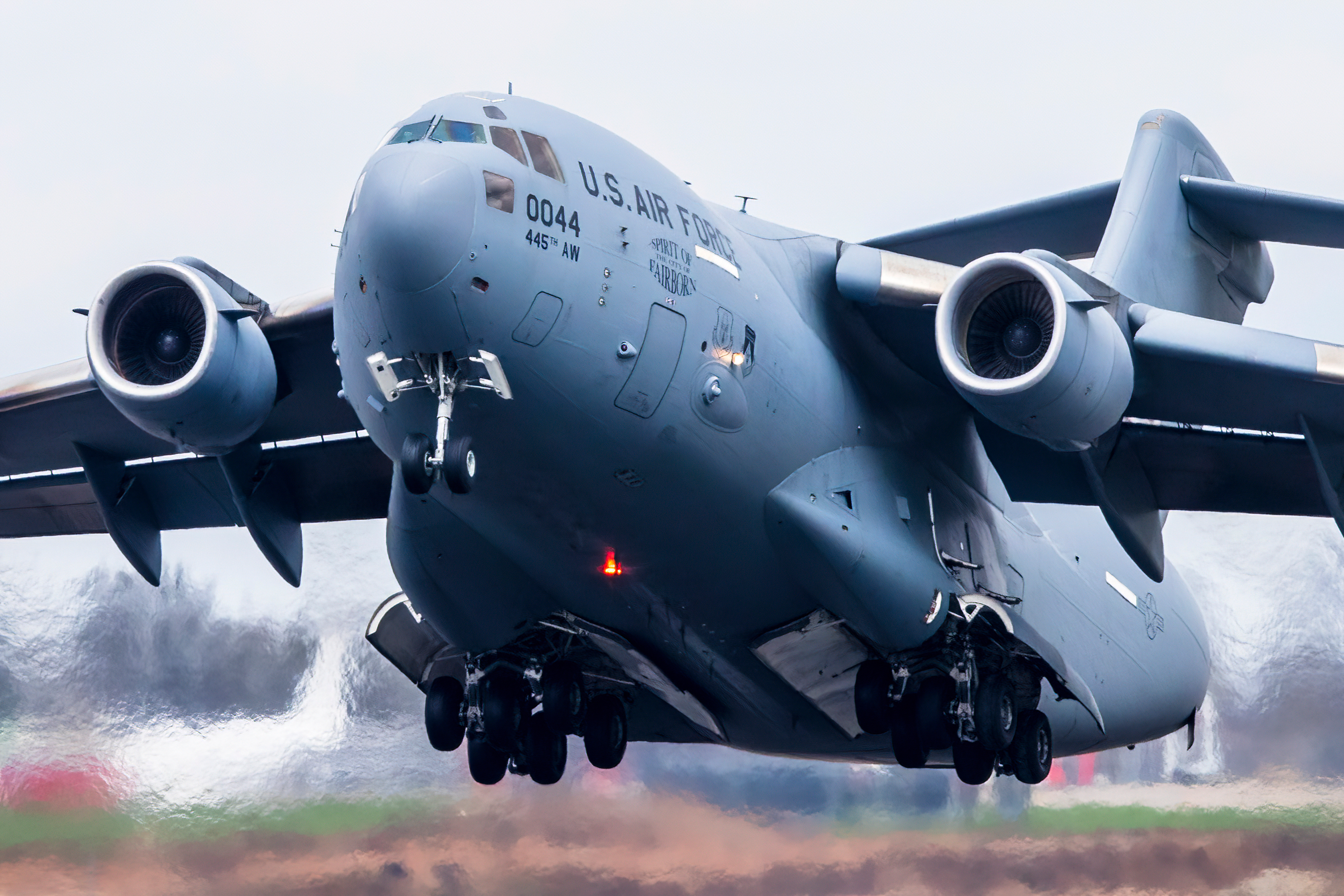
The U.S. Air Force’s C-17A Globemaster III. (Shutterstock
image)
As the U.S. Department of the Air Force strives for military
efficiency and environmental responsibility through its “Climate Action Plan
2023,” fuel consumption assumes noted importance.
In Objective 3.1, “Improve Operational Energy Intensity,”
Air Force flying missions should improve efficiency by 5% by FY27 and 7.5% by
FY32, specifically through aircraft drag reduction technologies.
Research conducted by AFIT Advanced Study of Air Mobility
(ASAM) student, Maj. William J. Lawrence, AFIT Operational Sciences Department
Head, Dr. William Cunningham, and AFIT Adjunct Assistant Professor and
Commander, 502nd Logistics Readiness Squadron, Lt. Col. Amanda Femano, Ph.D.,
explores the method of “fuel trimming” through counteracting aerodynamic
imbalances through Moving Mass Fuel Trimming (MMFT).
In “Throwing Your Weight Around: Fuel Trimming to Reduce
Drag in the C-17A,” published by the Logistics Officer Association (LOA), MMFT
is a concept where aircrews minimize aileron input during cruise flight.
This approach has proven to significantly reduce drag, and
results in substantial cost savings. For
example, simulator testing during the team’s research validated the concept,
and revealed a potential annual savings of over $2M and a reduction of 2,724
metric tons of carbon dioxide (CO2) across the USAF fleet of C-17As.
“The study focused on shifting fuel to balance the aircraft
in the roll axis, offsetting drag induced by factors like the Auxiliary Power
Unit (APU) housing. This method utilizes sensors already present on the
aircraft, making for easier adjustment.
“Fuel is strategically moved between wing tanks using the
existing fuel management system, minimizing the need for continuous control
surface adjustments. The results show the ability to measurably reduce force at
the aileron, and by reducing the amount of aileron deflection needed, the
amount of fuel to balance can be found and reduced,” said Lt. Col. Amanda
Femano.
The AFIT team’s research paves the way for industry-wide
changes, with the potential for influencing commercial aviation to adopt
similar fuel-saving strategies, while also highlighting the potential to expand
payload and range. By acting on these findings, greater savings, as well as
flexibility for command, plan, and operator decision making can be gained.
To learn more about AFIT’s Department of Operational Sciences programs and research, visit https://www.AFIT.edu/ENS. For more in-depth information regarding this research or to read the complete article, visit https://atloa.org/throwing-your-weight-around/.
AFIT’s Graduate School of Engineering and Management (GSEM) provides in-residence and distance learning graduate degrees and certificates in engineering, applied science, mathematics, and management. GSEM provides its students with several significant advantages, including a more personalized educational experience, academic programs with a defense-related focus, and research on high-priority defense problems.
About AFIT
AFIT is located at Wright-Patterson AFB, Ohio. AFIT’s mission is to educate defense professionals to innovatively accomplish the deterrence and warfighting missions of the USAF and USSF. AFIT’s vision is to lead defense-focused education, research and consultation to accelerate military superiority across all domains and is accomplished through operationally relevant advanced academic education, research, and professional continuing education. For more information, please visit the AFIT webpage https://www.afit.edu/ or contact EN outreach, AFIT.EN.Outreach@us.af.mil.