Cold Region Expeditionary Medical Operations Chemical, Biological, and Radiological Patient Decontamination Research
By Dr. Jeremy Slagley
Air Force Institute of Technology
The 711th Human Performance Wing (711 HPW) of the Air Force
Research Laboratory (AFRL) has sponsored medical patient decontamination
research at the Air Force Institute of Technology's Nuclear Expertise for Advancing Technologies (NEAT) Center since 2018. Because AFIT had already developed
methods to estimate human exposure risk from residual chemical, biological, and
radiological (CBR) agents after medical patient decontamination, 711 HPW
sponsored the NEAT Center to investigate decontamination options for Cold
Region Expeditionary Medical Operations (CREMO). AFIT’s NEAT Center has a CRADA
agreement for shared laboratory space at AV, Inc., in Beavercreek, Ohio.
As part of Air University’s broader mission to educate and
develop joint warfighters, AFIT provides advanced academic education and
research that prepares officers, enlisted members, civilians and international
partners to apply technical expertise in real-world operational environments,
supporting more informed and effective decision-making.
AF Civil Engineer (32E) and USMC Environmental Engineering
Management (8831) officers launched into the research, evaluating a commercial
off-the-shelf (COTS) mobile air shower system as well as modifying the existing
Multiple-Use Research for Particulate Hazard and Environmental Exposure
(MURPHEE) chamber (named for AFIT grad, Capt. Ed Murphy, Jr., of “Murphy’s
Law”). Students used manikins and surrogate CBR agents with low hazard,
comparing the air showers for ambulatory and litter-bound patients to other,
traditional methods of decontamination. For surrogate biological and
radiological dry aerosols, a high efficiency particulate air (HEPA) vacuum was
used. For surrogate chemical agents, liquid and vapor absorption methods were
used.
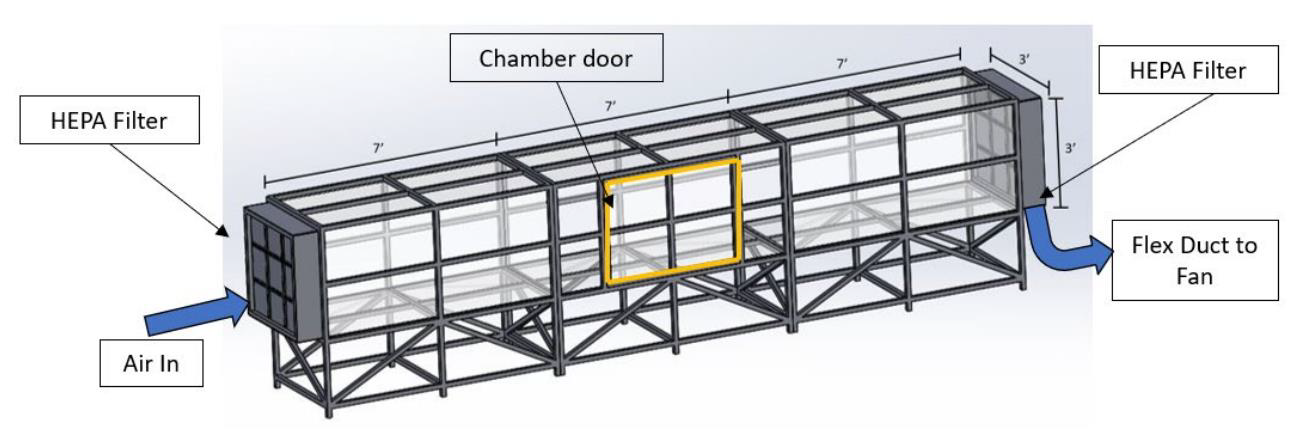
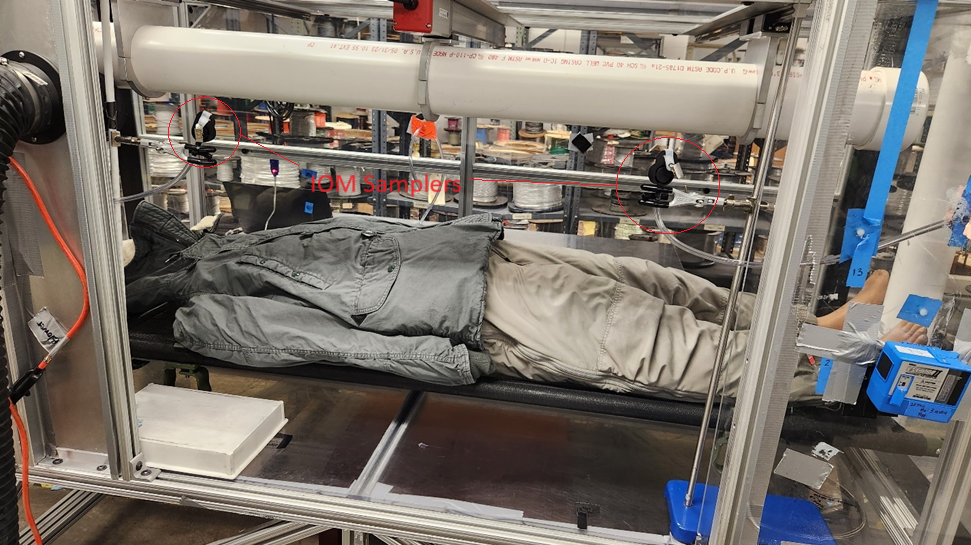
The illustration and photo above show AFIT’s Multiple-Use
Research for Particulate Hazard and Environmental Exposure (MURPHEE) chamber,
used in research to support research for the 711th Human Performance Wing of
AFRL. (U.S. Air Force graphic and photo)
AFIT researchers showed that the COTS system for ambulatory
patients approached 97-99% reduction in re-aerosolized risk for surrogate bio
and rad dry aerosols, compared to 84-90% reduction for manual HEPA vacuuming.
Litter-bound patient decontamination has been more difficult, achieving 90%
reduction for biological surrogates, but performing worse than no
decontamination for radiological surrogates. Air-based chemical agent
decontamination removes the evaporated agent by 80% but does not remove the
liquid agent from continuing to evaporate. The Air Combat Command Medical
Modernization Office has asked the NEAT Center to develop a prototype
transportable automated litter-bound patient decontamination system for CREMO
environments in FY26-27.
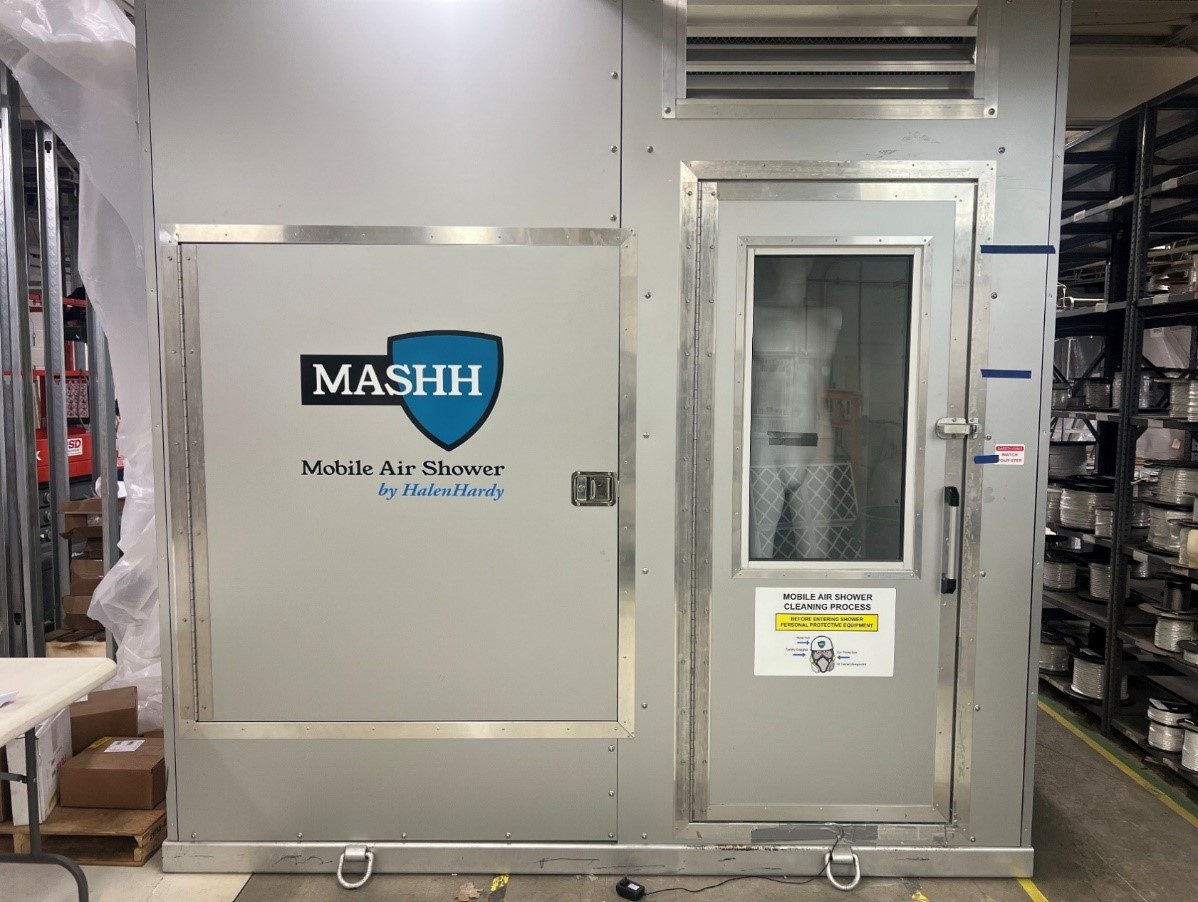
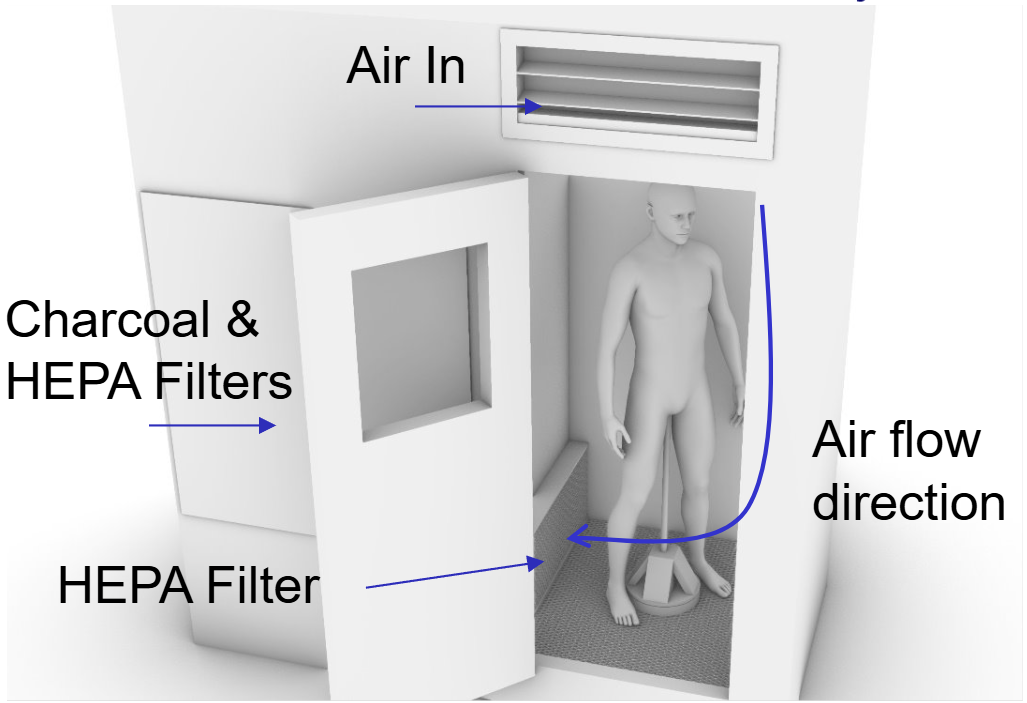
Commercial
off-the-shelf (COTS) mobile air shower system. (U.S. Air Force graphic and
photo)
About AFIT
AFIT’s Graduate School of Engineering and Management (GSEM) provides in-residence and distance learning
graduate degrees and certificates in engineering, applied science, mathematics
and management. GSEM provides its students with several significant advantages,
including a more personalized educational experience; academic programs with a
defense-related focus, and research on high-priority defense
problems.
AFIT is located at Wright-Patterson AFB, Ohio. AFIT’s
mission is to educate defense professionals to innovatively accomplish the
deterrence and warfighting missions of the USAF and USSF. AFIT’s vision is to
lead defense-focused education, research and consultation to accelerate
military superiority across all domains and is accomplished through
operationally relevant advanced academic education, research, and professional
continuing education. For more information, please visit the AFIT webpage or
contact GSEM outreach at AFIT.EN.Outreach@us.af.mil.