AFIT Department of Engineering Physics Research Receives HPLSE Editor-in-Chief Award
By AFIT Department of Engineering Physics Faculty
Air Force Institute of Technology
A team of faculty members and graduate students within AFIT’s Department of Engineering Physics were recognized with the High Power Laser Science and Engineering (HPLSE) journal’s prestigious “2024 Editor-in-Chief Choice Award” for their research article entitled, “Detailed characterization of kHz-rate laser-driven fusion at a thin liquid sheet with a neutron detection suite.”
The team’s research was originally featured on the journal’s Vol. 12, Issue e2 cover and named “Editor’s Pick,” before being selected as the 2024 Editor-in-Chief Choice Award winner. The HPLSE journal is a publication of the Cambridge University Press and evaluates papers based on the quality, downloads, citations, and the importance of the work to the field.
The research paper demonstrated the first-ever kHz-rate neutron generation and mixed radiation source in the world. HPLSE’s Editor-in-Chief Choice award is an outstanding recognition of the ground-breaking research by faculty and students within AFIT’s Extreme Light Lab (ELL).
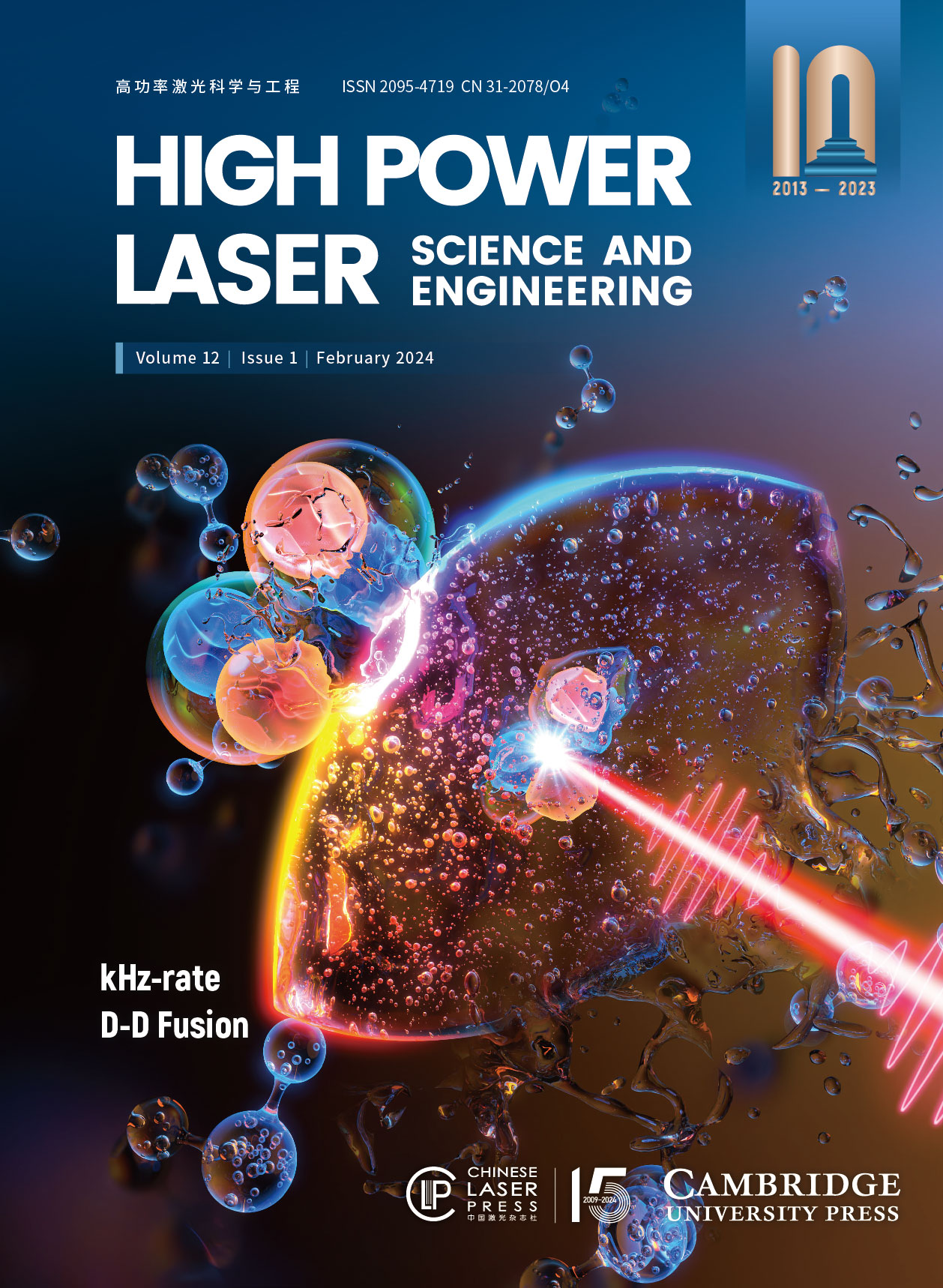
The High Power Laser Science and Engineering journal featured
published research by AFIT faculty members and students
on the cover of Vol.
12, Issue e2. (Cover illustration by HPLSE journal)
The extreme light group’s research is co-led by AFIT Professor of Physics, Dr. Anil Patnaik, and AFIT Research Assistant Professor and Center for Technical Intelligence Studies (CTISR) Director, Dr. Michael Dexter. Research paper co-authors included AFIT Assistant Professor, Dr. Juan Manfredi, AFIT Lab Technician, Mr. Kyle Frische, and AFIT alumni Dr. Connor Gautam (Ph.D. Nuclear Engineering, 2025) and Capt. Bryan Egner (Ph.D. Nuclear Engineering, 2021 and M.S. Nuclear Engineering, 2019). AFIT student co-authors included Mr. Benjamin Knight, (M.S. Nuclear Engineering, 2024) and Mr. Colton Stoner (M.S. Applied Physics, 2023). Additional collaborators included The Ohio State University and Marietta College. The research was sponsored by Air Force Office of Scientific Research (AFOSR) Program Officer, Dr. Andrew Stickrath.
“Our paper demonstrated the first-ever kHz-rate, 100,000 neutrons-per-second generation from intense fs-laser-plasma interaction by employing our 10-mJ class tabletop laser. We measured those ‘hard to measure’ neutrons with a suite of three different type of detectors to show generation mono-energetic neutron at ~2.5 Mev. We utilized our unique homegrown liquid target to achieve about a million deuterium-deuterium nuclear fusion events occurring at each millisecond,” said Dr. Patnaik.
The kHz-rate DD fusion enables a unique high-data rate, mixed radiation source testbed that is critical for testing equipment in challenging radiation environments and can be used for either terrestrial or space applications. The testbed could prove useful for testing electronic assets to be used by the U.S. Air and Space Forces.
Over the long-term, with the new planned upgrade of the laser system and in combination with pulse power system, the testbed could mimic the space environment, providing a cost-effective way to test and validate models for critical space assets. A fully-operational testbed could potentially save a billion dollars spent on testing assets over a two-to-three-year span.
“The current radiation damage tests are prohibitively expensive because of the need to implement different radiation sources for radiation damage tests sequentially,” said Dr. Patnaik. “Also, most of the controlled radiation sources rely on single-shot sources, such as those in particle accelerators, cyclotrons or single-shot, high-intensity laser-based particles at NIF. The high-data rate of the mixed radiation source at Extreme Light Lab (ELL) enables machine learning (ML) based testing and design of critical USAF and USSF assets.”
The research has already been progressing toward ML based optimization of the radiation mix, which is critical for mimicking different radiation environments. Furthermore, with the proposed upgrade of the ELL laser, the fluence per shot is expected to increase by a few orders of magnitude that would create a much higher-energy-density radiation environment and increase the application space.
The Department of Engineering Physics conducts research through AFIT’s Center for Technical Intelligence Studies and Research (CTISR), the Center for Directed Energy (CDE) and the Nuclear Expertise for Advancing Technologies (NEAT) Center. To learn more about AFIT’s physics degree programs and graduate certificates, please visit https://www.afit.edu/ENP/.
To read the published article in High Power Laser Science and Engineering, visit https://e.AFIT.edu/vvll9vw7.
The Graduate School of Engineering and Management (GSEM) provides in-residence and distance learning graduate degrees and certificates in engineering, applied science, mathematics and management. GSEM provides its students with several significant advantages, including a more personalized educational experience, academic programs with a defense-related focus, and research on high-priority defense problems.
ABOUT AFIT
AFIT is located at Wright-Patterson AFB, Ohio. AFIT’s mission is to educate defense professionals to innovatively accomplish the deterrence and warfighting missions of the USAF and USSF. AFIT’s vision is to lead defense-focused education, research and consultation to accelerate military superiority across all domains and is accomplished through operationally relevant advanced academic education, research, and professional continuing education. For more information, please visit the AFIT webpage https://www.AFIT.edu/ or contact the Graduate School of Engineering and Management at AFIT.EN.Outreach@us.af.mil.