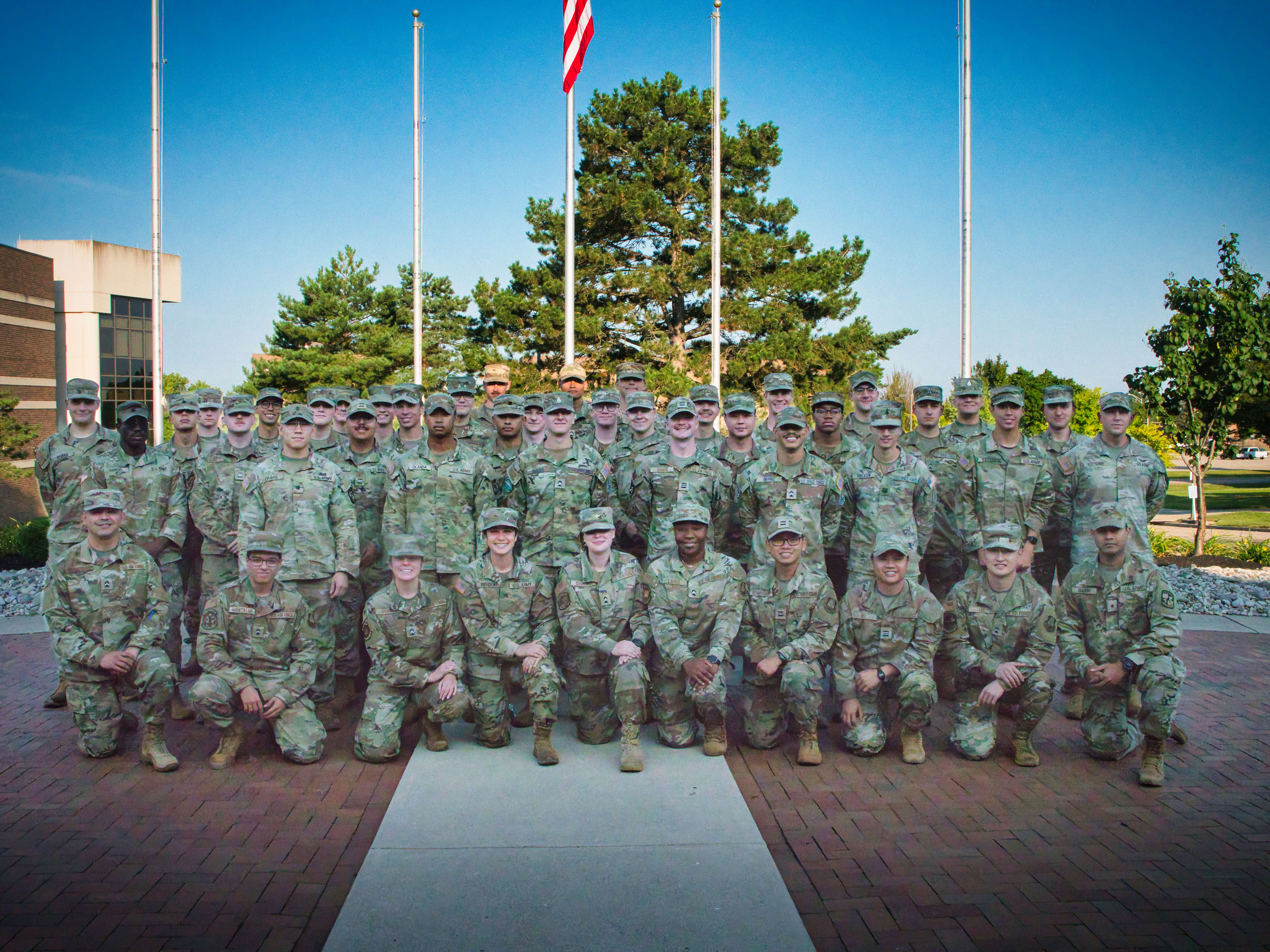
Graduates celebrate completing the Air Force Institute of Technology’s Immersive Cyber Education program. ICE is a multi-week program hosted annually during undergraduate academic summer break by the Air Force Cyberspace Technical Center of Excellence and Center for Cyberspace Research at AFIT. The program targets Reserve Officer Training Corps (ROTC) cadets from diverse academic backgrounds. (U.S. Air Force photo by Mark McDonald)
By Cadet Jadon Teh & Cadet Cameron Harvey
AFIT ICE Program Students
All it takes is one person with a computer and malicious intent to disrupt devices and services that have become integral to the modern nation. However, protecting our nation requires teams of highly talented cyber leaders.
The rise of the “Fifth Domain” of warfare, or cyber domain, has created an increased demand for cyber professionals. The Air Force Institute of Technology’s (AFIT) Immersive Cyber Education (ICE) program prepares these future cyber leaders by teaching them how to ethically use cyber tools to protect or exploit devices and networks in response.
AFIT’s ICE program is a multi-week program hosted annually during undergraduate academic summer break by the Air Force Cyberspace Technical Center of Excellence (AF CyTCoE) and Center for Cyberspace Research (CCR) at AFIT, Wright-Patterson AFB, Dayton, Ohio. The program targets Reserve Officer Training Corps (ROTC) cadets from diverse academic backgrounds.
During the intensive five-week period, cadets engaged in rigorous hands-on lessons that extended far beyond traditional classroom settings. The curriculum encompassed networking, cryptography, reverse engineering, firmware analysis, artificial intelligence, and offensive and defensive cyber techniques. Practical applications included a preparatory capture-the-flag event and a Hackfest competition where cadets tested their skills in live scenarios. Leadership and mentorship sessions from the USAF and Army officers rounded out the experience with valuable lessons and wisdom.
For many participants, ICE represented their first deep exposure to cybersecurity.
“I am fortunate for the chance to train my breadth of knowledge with cybersecurity. I was surprised how in-depth some of the modules were and how the program surpassed the depth of knowledge I’ve gained in the last several years.
Many universities are lacking in cybersecurity courses, and this program provides an opportunity for cadets to get the necessary cybersecurity experience that would otherwise be unavailable to them,” said Russell Rivard, Army ROTC, Texas A&M University.
Peter Mora IV, Brown University, United States Space Forces (USSF) ROTC, described ICE as the program he had been seeking since joining ROTC.
“The program fuses military culture and leadership training with a rigorous, master’s-level curriculum taught by cyber operators and technical experts. AFIT managed to pack in-depth lectures and live, hands-on demos into four weeks. The experience gave me confidence and competency beyond what a traditional undergraduate education could offer, ” said Mora.
Academic year 2025’s cohort included 45 cadets from the U.S. Army, USSF, and USAF studying law enforcement, political science, systems engineering, management information systems, computer science, and cyber security engineering.
As conflicts grow more technologically complex, AFIT ICE ensures cadets are ready to lead in the ever-evolving cyber domain.
The program builds fundamental cyber-attack and defense skills through comprehensive training. Faculty expose cadets to tools that can secure and defend systems or infiltrate and disrupt adversarial networks. The curriculum covers related cyber and electronic warfare topics including cryptography, digital forensics, firmware, and software reverse engineering. Additionally, cadets gain valuable experience leading peers from other service branches in a joint-force environment.
While open to cadets from most backgrounds, those with prior programming or cybersecurity experience may benefit most from the advanced curriculum. The program’s primary objective is to prepare tomorrow’s officers to understand and defend the networks and systems that underpin national security.
For more information on AFIT’s ICE program, and to view upcoming application deadlines, visit www.AFIT.edu/ICE.
AFIT’s Graduate School of Engineering and Management (GSEM) provides in-residence and distance learning graduate degrees and certificates in engineering, applied science, mathematics and management. GSEM provides its students with several significant advantages, including a more personalized educational experience, academic programs with a defense-related focus, and research on high-priority defense problems.
About AFIT
AFIT is located at Wright-Patterson AFB, Ohio. AFIT’s mission is to educate defense professionals to innovatively accomplish the deterrence and warfighting missions of the USAF and USSF. AFIT’s vision is to lead defense-focused education, research and consultation to accelerate military superiority across all domains and is accomplished through operationally relevant advanced academic education, research, and professional continuing education. For more information, please visit the AFIT webpage https://www.afit.edu/ or contact the Graduate School of Engineering and Management at AFIT.EN.Outreach@us.af.mil.
