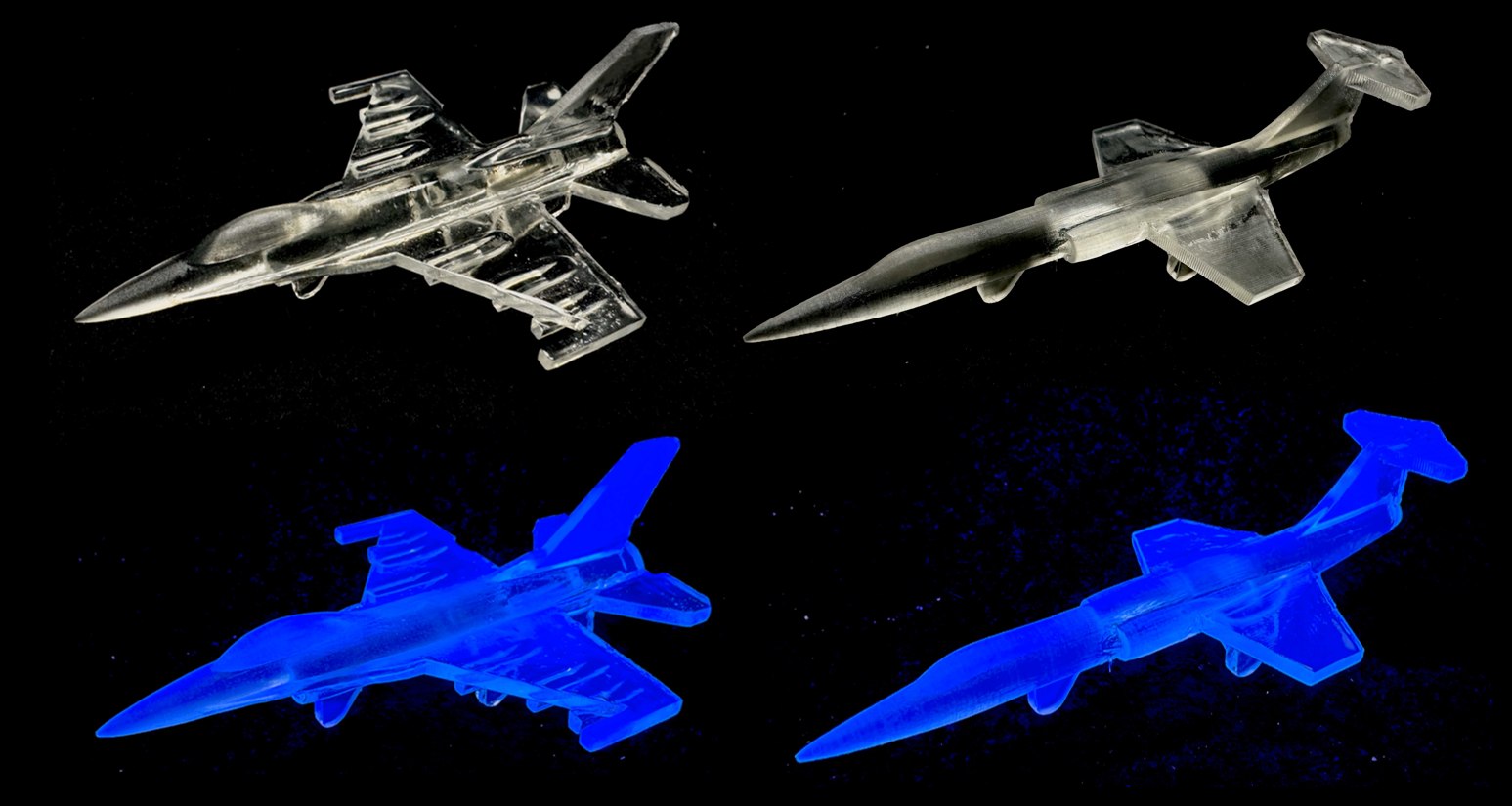
High-resolution 3D-printed planes, made of a scintillating
plastic material, emit light in response to radiation (U.S. Air Force image).
By Juan J. Manfredi Jr.
Air Force Institute of Technology
A recent project sponsored by the Department of Energy (NNSA
DNN R&D) at Oak Ridge National Laboratory (ORNL) pursued a 3D-printing
approach for creating pixelated plastic scintillator arrays to improve
manufacturing time and cost.
Chandler Moore, a doctoral student at the Air Force Institute
of Technology (AFIT), part of Air University, led the AFIT effort to support
this project. Mr. Moore designed, constructed, and programmed a custom 3D
printer for making pixelated arrays that can detect and distinguish neutrons
and gamma rays, two important types of ionizing radiation.
Ionizing radiation is invisible to the human eye yet must be
observed and tracked for national security purposes. Radiation detectors are
devices that convert the information from ionizing radiation to more easily
processed optical and electrical signals. One such type of detector is the
scintillator, which emits light in response to ionizing radiation.
Although scintillators have been used effectively for many
decades, traditional manufacturing processes are often slow and limited in
being able to produce complicated geometries, such as pixelated scintillator
arrays useful for certain imaging applications. The advent of additive
manufacturing (also known as 3D printing) has opened the possibility to the
fast and customizable production of plastic scintillators in arbitrary
geometries.
This manufacturing process represents significant
improvements on the existing state-of-the-art in terms of cost and labor, and resolution
of the final product. During this effort, Mr. Moore also collaborated with ORNL
to develop a novel 3D-printable scintillator resin for making high-resolution
scintillator geometries (as shown in the figure).
Moore’s work resulted in the authorship of two published
peer-reviewed papers. He also spent a summer at Lawrence Livermore National
Laboratory helping with their efforts to develop 3D-printable plastic
scintillator materials.
Additionally, Moore’s work on scintillator development successfully
met sponsor deliverables, and advances radiation detection capabilities
relevant to the Air Force: such as emergency response, treaty monitoring, and
atmospheric radiation monitoring. Other AFIT personnel involved in this work
include Dr. Juan Manfredi, Dr. Michael Febbraro (who wrote the original
proposal), Dr. Daniel Rutstrom, Lt. Col. Ryan Kemnitz, and Lt. Col. AndrewDecker.
The views expressed are those of the authors and do not reflect the official guidance or position of the United States Government, the Department of Defense, the United States Air Force or the United States Space Force.
AFIT is located at Wright-Patterson AFB, Ohio. AFIT’s mission is to educate defense professionals to innovatively accomplish the deterrence and warfighting missions of the USAF and USSF. AFIT’s vision is to lead defense-focused education, research and consultation to accelerate military superiority across all domains and is accomplished through operationally relevant advanced academic education, research, and professional continuing education. For more information, please visit the AFIT webpage https://www.afit.edu/ or contact GSEM outreach at AFIT.EN.Outreach@us.af.mil.
