By Dr. Marilyn Dunbar
Air Force Institute of Technology-Air Force Research Laboratory (AFIT-AFRL)
Post-Doctoral Research Fellow
In 2025, the Air Force Institute of Technology’s Engineering Physics Department and Center for Directed Energy (ENP/CDE) participated in a multi-university campaign to uncover the dynamics of fog in the Arctic. This research can be applied to any low-flying air-based Air Force mission that requires accurate weather forecasting in locations that experience freezing fog and ice fog.
Led by the University of Notre Dame, the goal of the campaign, known as FATIMA-IF (Fog and Turbulence Interactions in a Marine Atmosphere – Ice Fog), was to uncover the mechanisms underlying the formation of freezing fog and ice fog and to better inform current models to produce more accurate visibility forecasts. The research was conducted at the Atmospheric Radiation Measurement site in Utqiagvik, Alaska; which was formerly known as Barrow, Alaska.
Fog is a common phenomenon observed throughout the globe in many environments. It can show up in many forms, such as liquid, supercooled liquid, and under the right conditions, ice fog. To set the fog-production process in motion, all it takes is the right amount of humidity and a small particle, like pollen, dust, or bacteria for a full-blown visibility-reducing nightmare to occur.
In very remote areas, such as the Arctic, forecasters rely heavily on the models used to accurately forecast fog and its effects on visibility. From a transportation and safety perspective, this is especially important due to Arctic amplification (Rantanen et al., 2022), or the rapid warming in the Arctic that dynamically changes the environment. Additionally, arctic amplification is constantly changing the historically accurate particulate concentrations, which also provides ample opportunity for more fog events to occur.
Not only is the ability to accurately predict and forecast fog in the Arctic an important transportation and safety consideration, but collecting the data to feed into the forecasts is also crucial. The data that is necessary to predict and forecast fog includes information on the microphysical aspects of fog, such as measuring visibility, turbulence, and weather conditions. Additional aspects on the fog itself, such as particulate concentrations, optical properties of fog, and the possible particulates responsible for producing fog in such remote areas are also necessary.
Dr. Marilyn Dunbar, AFIT-AFRL post-doctoral research fellow, collected and analyzed data for AFIT’s contribution during the campaign. Throughout the campaign, a multitude of data were collected, in addition to human observations of fog events, an example of which is shown in figure 2.
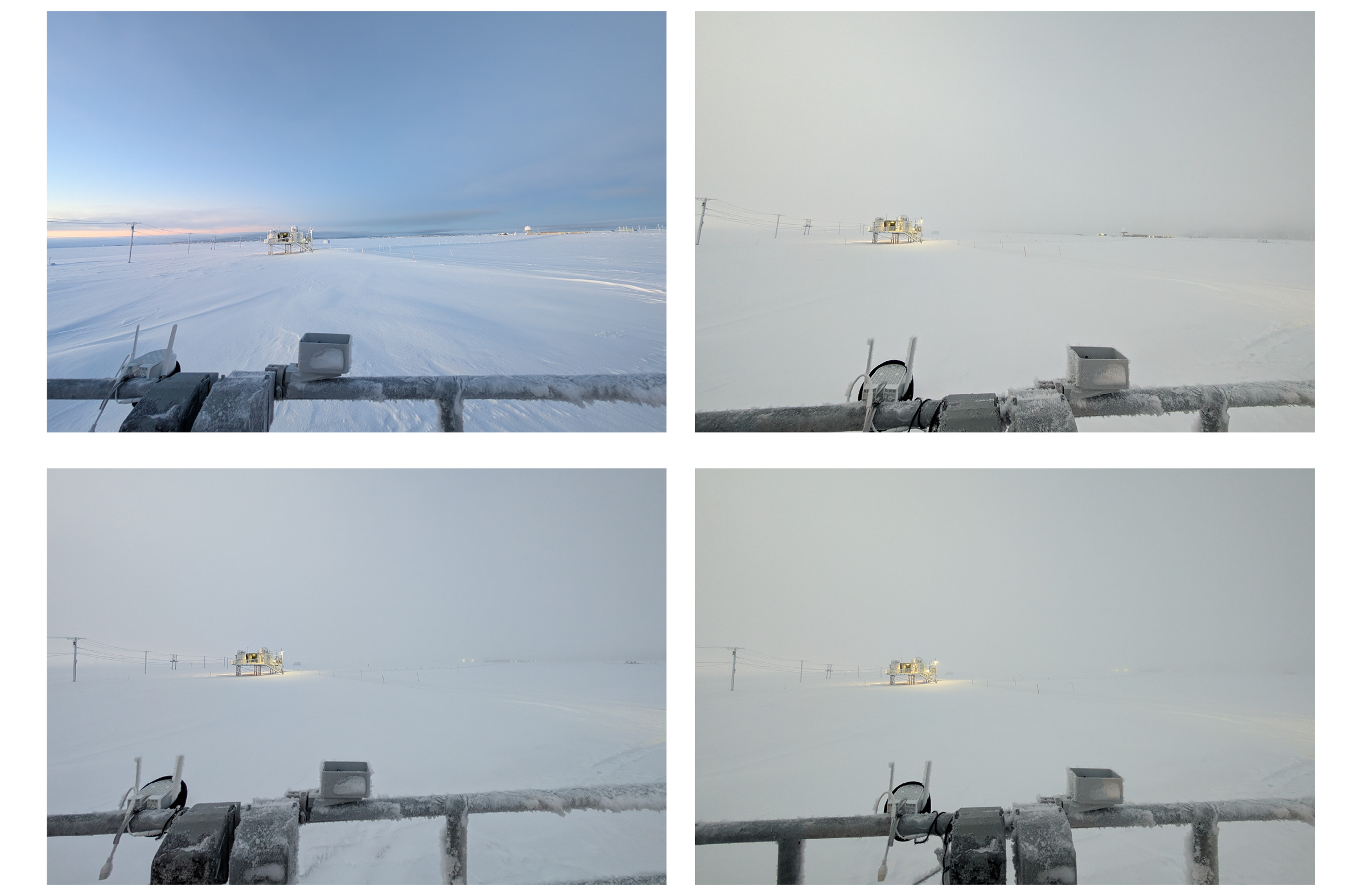 Figure 2. Data from the FATIMA-IF campaign in Utqiagvik, Alaska, shows clear conditions on November 23, 2025, at 11:37 Alaska Standard Time (AKST) at the FATIMA-IF site (top left). A few hours later, AFIT records reductions in visibility from on-set fog conditions at 3:03 AKST (top right), 3:09 AKST (bottom left), and 3:12 AKST (bottom right). (U.S. Air Force contributed photos by Dr. Marilyn Dunbar)
In figure 2, under clear conditions (top left), the horizon and other nearby landmarks, such as the balloon launcher and a nearby Air Force installation, are clearly visible at distances of approximately 76 and 800 meters from the observer, respectively.
However, during a fog event, as shown around 3 p.m. Alaska Standard Time (AKST) on November 23, 2025, the reduction in visibility is clearly indicated over six minutes as the Air Force installation becomes harder to see in the distance.
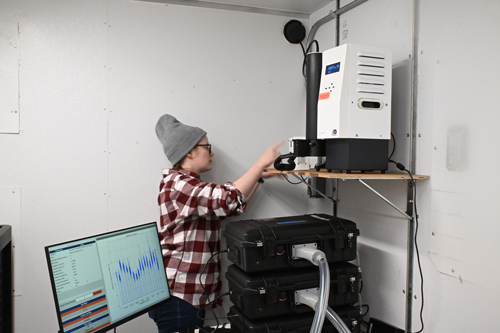
During the campaign, AFIT deployed aerosol instrumentation specialized for sampling small particulate matter, such as bacteria and other fog-causing particulates, called the Cloud Ice Nucleation Characterization System (CINCS). The CINCS is the white instrument shown in figure 1.
AFIT also deployed aerosol extinction analyzers, or Optical Extinction Analyzers (OEAs), and are the black instruments in figure 1. OEAs measure how much light is absorbed or scattered by a sample as it enters the instrument.
As shown in figure 3, the collected data have been preliminarily plotted alongside other data from the FATIMA-IF campaign. The data shows the presence of fog events, which is indicated by an increase in the FM120 data, as indicated by the dark purple line, and a decrease in visibility reported by the FD70, or the orange-dashed line. On November 22, 2025, the 1064 nm OEA, or the black line in figure 3, also shows an increase in extinction on if the particles being ingested into the system are large enough.
In the case of smaller particles responsible for fog production, which was observed in figure 2 on November 23, 2025, the OEA in the far-right graph in figure 3 does not show an increase in extinction. This discrepancy is still under investigation and further data analysis from the campaign is still underway to understand the interplay between particulate concentrations and composition and the microphysical and optical properties of fog events observed at Utqiagvik, Alaska during this time.
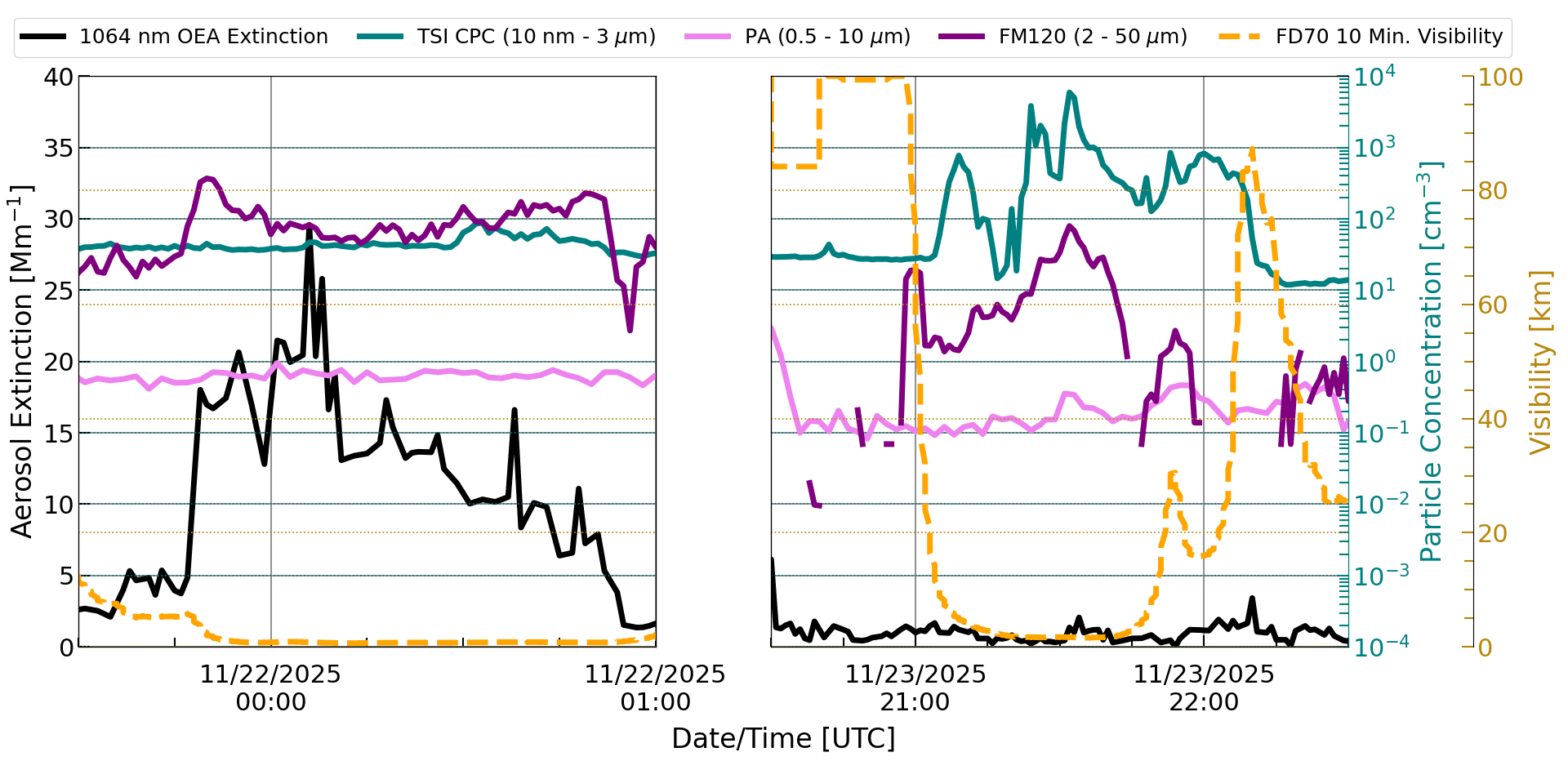
Figure 3. Aerosol extinction data collected at 1064 nm by an Optical Extinction Analyzer OEA, black line, in comparison to particle concentrations in
cm-3 by a TSI Condensation Particle Counter or CPC, teal line, Purple Air, or PA, pink line, and DMT Fog Monitor, FM120, purple line and visibility in
km reported by a Visala FD70 for November 22, 2025 (left) and November 23, 2025 (right). Times shown are in Coordinated Universal Time.
(Data provided by Dr. Marilyn Dunbar)
References:
Rantanen, M., Karpechko, A. Yu., Lipponen, A., Nordling, K., Hyvärinen, O., Ruosteenoja, K., Vihma, T., & Laaksonen, A. (2022). The Arctic has warmed nearly four times faster than the globe since 1979. Communications Earth & Environment, 3(1), 168. https://doi.org/10.1038/s43247-022-00498-3
ABOUT AFIT
AFIT’s Graduate School of Engineering and Management (GSEM) provides in-residence and distance learning graduate degrees and certificates in engineering, applied science, mathematics and management. GSEM provides its students with several significant advantages: a more personalized educational experience, academic programs with a defense-related focus, and research on high-priority defense problems.
AFIT is located at Wright-Patterson AFB, Ohio. AFIT’s mission is to educate defense professionals to innovatively accomplish the deterrence and warfighting missions of the USAF and USSF. AFIT’s vision is to lead defense-focused education, research and consultation to accelerate military superiority across all domains and is accomplished through operationally relevant advanced academic education, research, and professional continuing education. For more information, please visit the AFIT webpage https://www.AFIT.edu/ or contact GSEM outreach at AFIT.EN.Outreach@us.af.mil.
