(Shutterstock image)
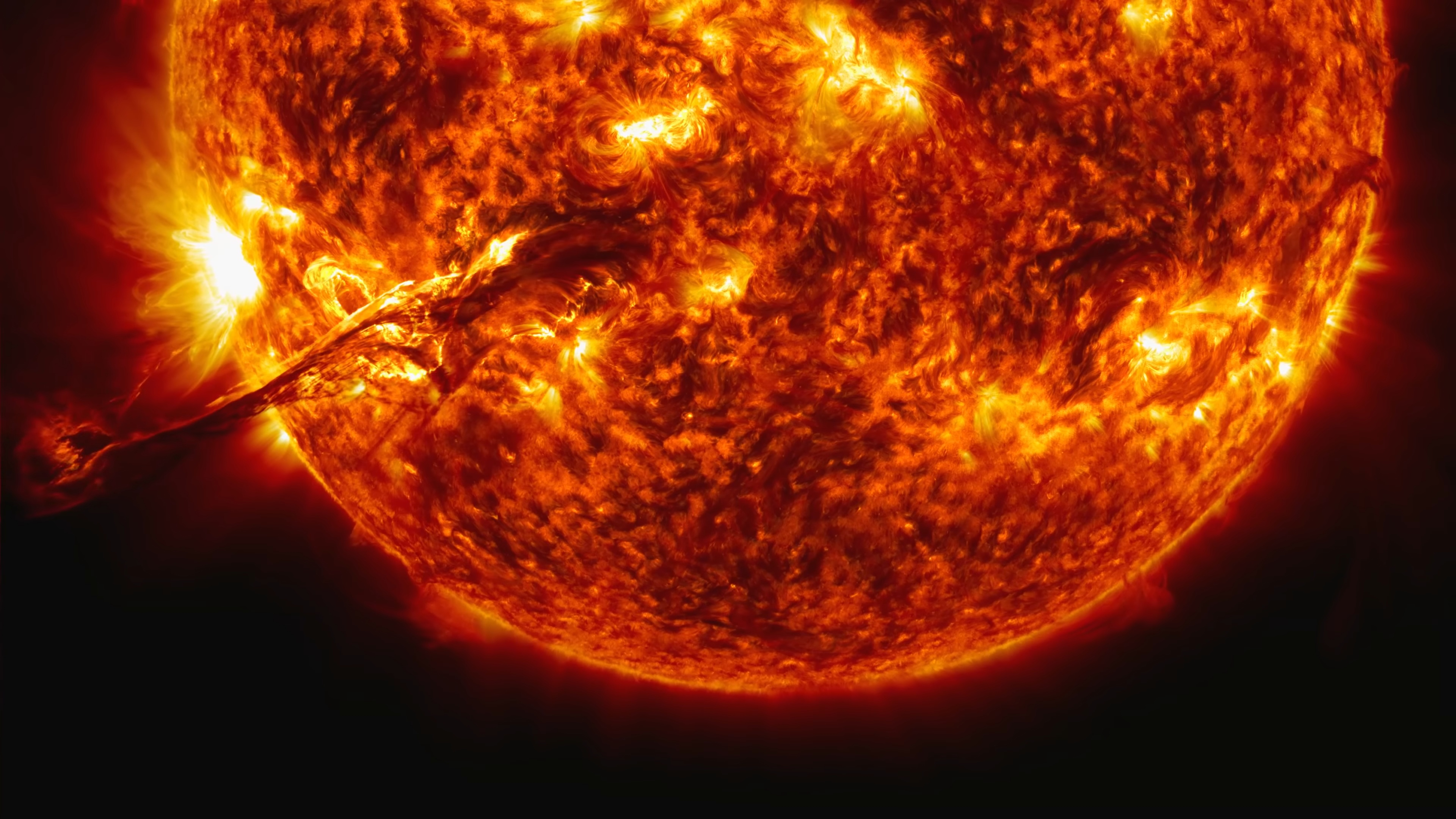
The Air Force Institute of Technology’s 1st Lt. Kara Kniezewski, Applied Physics doctoral student, Capt. Seth Garland, master’s thesis advisor and heliophysicist committee member, and Emily Mason from Predictive Science, Inc., have analyzed extreme ultraviolet emissions in coronal loops above solar active regions to improve forecasting capabilities and better understand the short-term dynamics leading to solar flares.
Solar flares are the most energetic eruptions in our solar system, releasing a broad spectrum of electromagnetic radiation and fast-moving particles that can impact satellites and High Frequency radio propagation. While scientists have searched for a method to predict eruptions over the last several decades, there have only been minor advances in our ability to forecast. The most widely used forecasting method for solar flares is climatological, providing a probability of occurrence based on magnetic fields measured on the surface of the sun, or the photosphere. However, this climatological approach does not provide information on the timing of an eruption.
Through the analysis of 50 solar flares, Lt. Kniezewski et al. found that EUV emissions begin to flicker erratically a few hours before eruption. This new finding, published in Astrophysical Journal Letters, provides insight into observations that can be used as indicators for an impending solar event. While every solar flare is unique in some way, this common chaotic behavior before eruption provides a good indicator of impending activity. Combining the EUV fluctuations with existing models that rely on measured magnetic fields may provide an innovative approach for forecasting the timing and severity of these extreme solar eruptions.
According to Lt. Kniezewski, “As we grow more dependent on technology as a society and as a defense department, protecting our air and space assets has become crucial, and current forecasting capabilities do not provide consistent lead time to prepare for an upcoming eruption.
Large solar flares, or even a succession of smaller flares, over the last two decades have exposed our vulnerable technological and communications infrastructure to space weather effects. A flare forecast that predicts when a flare will occur and how strong it will be is crucial to understand the current operational environment and protect DoD assets and personnel. Such a model can easily be implemented as part of the missions of the Space Weather Operations Center or Air Force Research Lab.”
This research was performed under AFIT’s Applied Physics master’s program, which provides DoD focused training and education on the space environment. Graduates of this program commonly serve in the Space Weather Operations Center, Air Force Research Laboratory, or Radio Solar Telescope Network detachments.
AFIT’s Graduate School of Engineering and Management (GSEM) provides in-residence and distance learning graduate degrees and certificates in engineering, applied science, mathematics and management. GSEM provides its students with several significant advantages, including a more personalized educational experience, academic programs with a defense-related focus, and research on high-priority defense problems.
About AFIT
AFIT is located at Wright-Patterson AFB, Ohio. AFIT’s mission is to educate defense professionals to innovatively accomplish the deterrence and warfighting missions of the USAF and USSF. AFIT’s vision is to lead defense-focused education, research and consultation to accelerate military superiority across all domains and is accomplished through operationally relevant advanced academic education, research, and professional continuing education. For more information, please visit the AFIT webpage https://www.afit.edu/ or contact the Graduate School of Engineering and Management at AFIT.EN.Outreach@us.af.mil.
