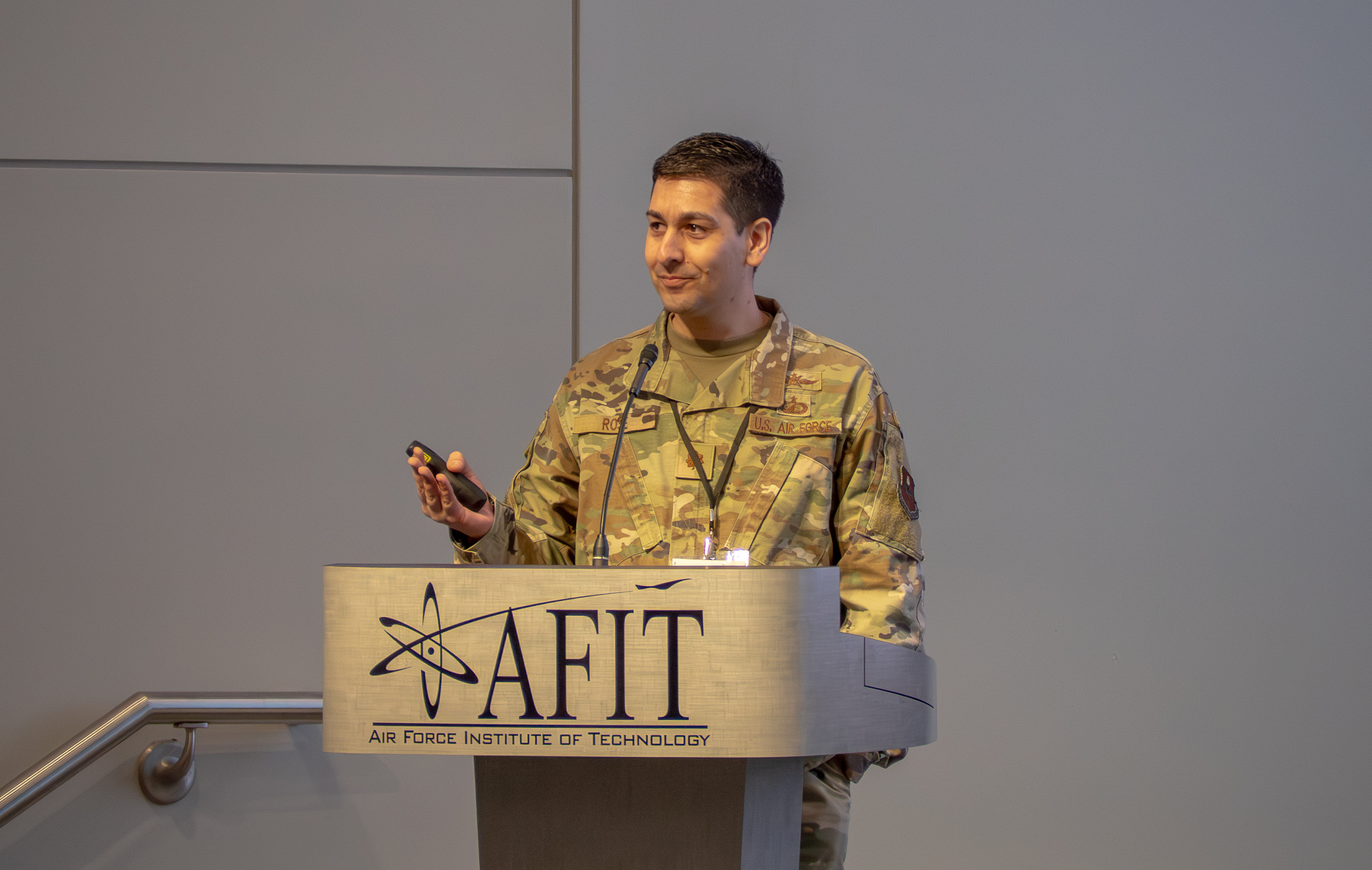
Maj. Anthony Rose, director of AFIT's Center for
Cyberspace Research, briefs the Center's mission and current research areas
in cyber and artificial intelligence. (U.S. Air Force photo by Mark McDonald)
To accelerate the integration of critical warfighting
technologies, the Air Force Institute of Technology (AFIT) convened key experts
for its inaugural Cyber and AI Colloquium held on 16-17 March 2026.
The forum was planned and coordinated by AFIT’s Air Force Cyber Technical Center of
Excellence (CyTCoE) with the assistance of AFIT’s Artificial Intelligence Technology Research
and Education Consortium (AI TREC) and Center
for Cyberspace Research (CCR) teams with a purpose of fostering
collaboration, sharing pioneering research and exploring the operational impact
of these critical technologies across the Department of the Air Force (DAF).
As part of Air University’s broader mission to educate and
develop joint warfighters, AFIT provides advanced academic education and
research that prepares officers, enlisted members, civilians and international
partners to apply technical expertise in real-world operational environments,
supporting more informed and effective decision-making.
The hybrid-format colloquium was attended by over 250
military and civilian leaders from pivotal organizations and major operational
commands, and signaled a unified effort to harness AI and cyber capabilities
for future military operations.
Thirty presentations were shared by U.S. Air Force, U.S.
Space Force, and selected Department of War organizations during the critical
exchange. Topics focused on cyber for AI, warfare dominance, and impactful AI applications
and AI for cyber topics.
In addition, a student poster session took place on the second day of the
event.
“This event created a powerful discussion meant to
accelerate development of mission-critical capabilities. Key outcomes included
strengthening collaboration across major organizations like AFIT, NASIC,
AFLCMC, and AFRL, and forging vital connections between the research and
operational communities,” said Ms. JoAnn Erno, Air
Force CyTCoE director.
“The event's overwhelming success and 94% recommendation
rate have solidified it as an essential, high-impact annual forum for advancing
DAF capabilities to rapidly innovate and deploy cyber and AI solutions
necessary to obtain and maintain a decisive advantage.”
Early feedback received from event attendees included: “this
is the only event of its kind” and “we need more of these exchanges.” These
responses illustrate a high interest in additional events and highlights the
impressive depth and breadth of research at AFIT.
Due to high attendance and positive impressions from the first
event, AFIT organizers have scheduled another session for 16-17 March 2027.
For more information about CyTCoE and future events, please visit
https://www.afit.edu/CYBER/ or contact
afit.cytcoe.workflow@us.af.mil.
About AFIT
AFIT’s Graduate School of Engineering and Management (GSEM)
provides in-residence and distance learning graduate degrees and certificates
in engineering, applied science, mathematics and management. GSEM provides its
students with several significant advantages: a more personalized educational
experience, academic programs with a defense-related focus, and research on
high-priority defense problems.
AFIT is located at Wright-Patterson AFB, Ohio. AFIT’s mission is to educate defense professionals to innovatively accomplish the deterrence and warfighting missions of the USAF and USSF. AFIT’s vision is to lead defense-focused education, research and consultation to accelerate military superiority across all domains and is accomplished through operationally relevant advanced academic education, research, and professional continuing education. For more information, please visit the AFIT webpage https://www.afit.edu/ or contact GSEM outreach at AFIT.EN.Outreach@us.af.mil.
