By Yogendra Raut
Air Force Institute of Technology
A thesis from the Air Force Institute of Technology (AFIT) presents a breakthrough in atmospheric characterization with direct implications for directed energy weapons and long-range optical communications.
The research, conducted by AFIT master of computer science alum, Joel Hottinger, under the guidance of Dr. Steven T. Fiorino, professor of engineering physics and director of AFIT’s Center for Directed Energy, demonstrates how machine learning can accurately predict soil heat flux (G), a critical environmental variable used in estimating optical turbulence that affects high-energy laser propagation.
Soil heat flux governs the transfer of thermal energy into and out of the ground and is a key component of the surface energy balance. Traditionally, measuring this quantity requires buried heat flux plates, which are difficult to deploy in tactical or rapidly changing operational environments. Existing empirical approaches also struggle to generalize across varying climates, vegetation types, and soil conditions.
To address this challenge, the study developed two machine learning approaches: an Artificial Neural Network (ANN) and a Long Short-Term Memory (LSTM) neural network. Using meteorological observations from nine AmeriFlux sites across North America, the models were trained and validated using only five standard atmospheric variables: pressure, air temperature, soil temperature, relative humidity, and net radiation.
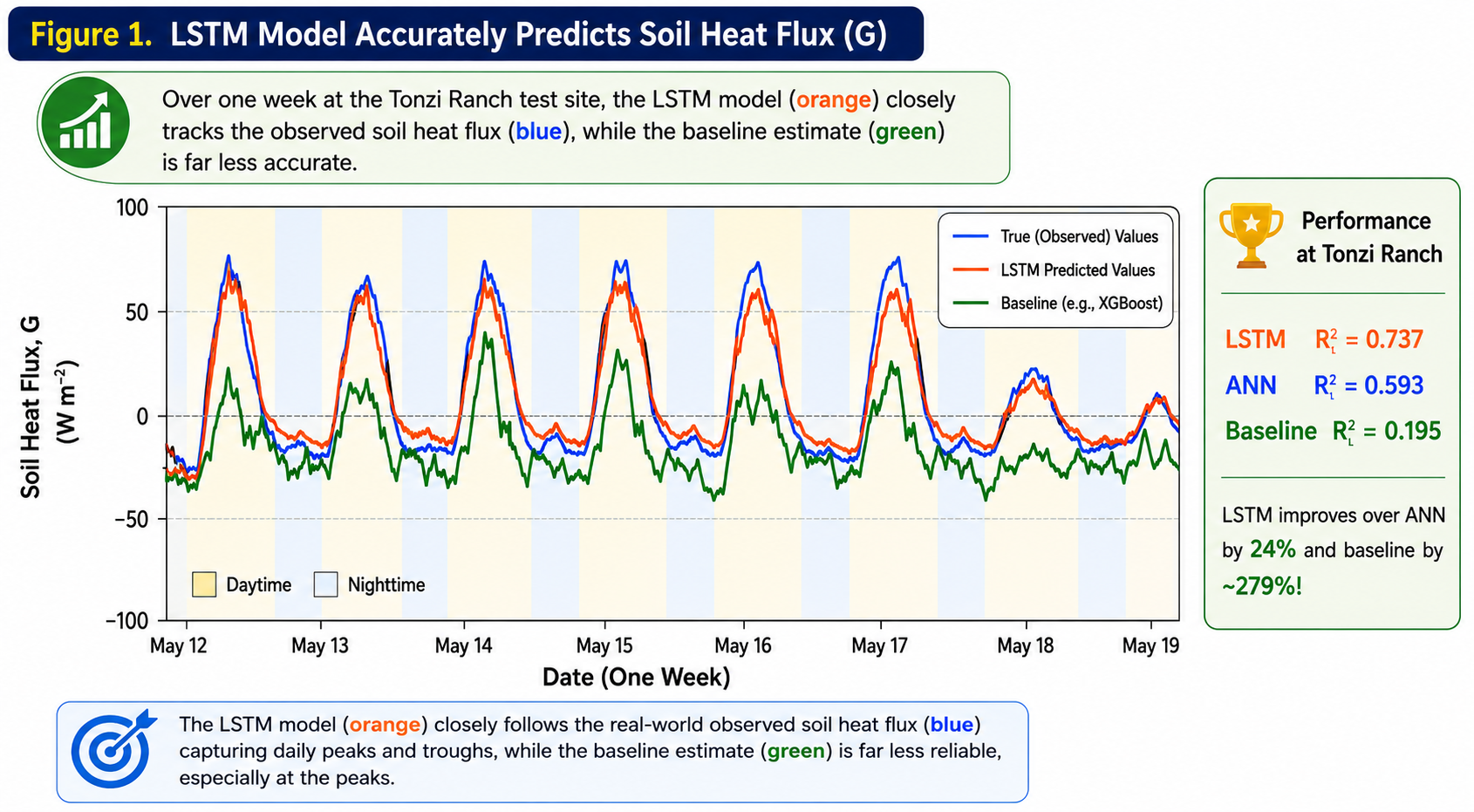
The LSTM model demonstrated particularly strong performance. At the Tonzi Ranch validation site, it achieved a correlation coefficient of R² = 0.737, outperforming both the ANN model and traditional empirical baseline methods. As shown in figure 1 below, the LSTM predictions closely follow the observed daily variability and peaks in soil heat flux, while the baseline estimate shows larger errors and weaker consistency during both daytime heating and nighttime cooling cycles.
The baseline estimate shown in green was approximated using a simplified empirical approach in which soil heat flux was estimated at approximately 20% of net radiation (Rn). Accurate prediction of soil heat flux directly improves estimation of sensible heat flux and atmospheric temperature structure, which are essential for calculating optical turbulence (Cn²).
This work provides a practical pathway toward improved atmospheric characterization for directed energy applications. By replacing difficult field measurements with accurate AI-driven predictions, the research enables more reliable forecasting of optical turbulence and supports enhanced laser system performance in operational environments.
Learn more about AFIT’s Department of Engineering Physics and its graduate degree and certificate programs at https://www.AFIT.edu/ENP.
(U.S. Air Force graphic)
ABOUT AFIT
AFIT’s Graduate School of Engineering and Management (GSEM)
provides in-residence and distance learning graduate degrees and certificates
in engineering, applied science, mathematics and management. GSEM provides its
students with several significant advantages: a more personalized educational
experience, academic programs with a defense-related focus, and research on
high-priority defense problems.
AFIT is located at Wright-Patterson AFB, Ohio. AFIT’s
mission is to educate defense professionals to innovatively accomplish the
deterrence and warfighting missions of the USAF and USSF. AFIT’s vision is to
lead defense-focused education, research and consultation to accelerate
military superiority across all domains and is accomplished through
operationally relevant advanced academic education, research, and professional
continuing education. For more information, please visit the AFIT webpage https://www.AFIT.edu/ or contact GSEM outreach
at AFIT.EN.Outreach@us.af.mil.
