Lt. Col. Robert A. Bettinger, an associate professor of aerospace engineering in AFIT’s Department of Aeronautics and Astronautics, has been working with mechanical engineering research assistant Philip D. Smith to develop an “articulating spacecraft chassis” based on the CubeSat form factor. Christian Conkle, a former Master of Science student at AFIT, also contributed to the work while pursuing his degree at the institute. Lt. Col. Bettinger, Mr. Smith, and Mr. Conkle recently received a patent from the U.S. Patent and Trademark Office related to discoveries achieved while conducting this work.
In this context, “chassis” refers to the satellite structure designed to hold a payload. Once a CubeSat satellite is fully integrated with payload and bus components, the vehicle is loaded into a dispenser, which is then integrated into the upper stage of a launch vehicle. Once in orbit, the dispenser ejects the satellite, allowing the payload to be used.
The problem that Lt. Col. Bettinger, Mr. Smith, and Mr. Conkle set out to address relates to the fact that it is not economically feasible to produce customized dispensers, as doing so would require significant (and prohibitively expensive) engineering work. Therefore, a satellite chassis must be manufactured to fit standardized dispenser sizes already available on the market. A CubeSat is built using a standard size of a single “Cube,” or “Unit” (“U”). A single U measures ten centimeters on all sides. Current CubeSat dispensers fit 1U, 3U, 6U, or 12U satellites. The requirement to adhere to these sizes, in turn, limits the size and shape of the payload a chassis can contain.
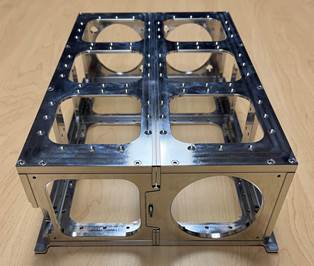
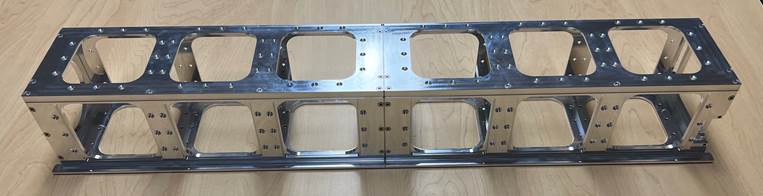
Lt. Col. Bettinger, Mr. Smith, and Mr. Conkle’s research has focused on broadening the versatility of the 6U model. Currently, the 6U satellite is organized into a 1 x 2 x 3 arrangement, which fits the size of existing dispensers. The necessity of adhering to this arrangement has posed challenges to the defense community. For example, longer telescopes with longer optical trains have different mission applications than shorter telescopes. However, to be launched into space in the current 6U chassis configuration, telescopes cannot be more than three “cubes” – or thirty centimeters – long. Placing a long but thin telescope into a larger 12U satellite might yield unused lateral space, which is also not ideal. Likewise, some types of sensors function more effectively when separated from one another, but the existing 6U configuration limits how far apart sensors may be placed.
The inventors’ innovation, however, allows the chassis to change configuration once it has been ejected from the dispenser. Functionally, the chassis splits in half and expands into a longer 1 x 1 x 6 configuration. This innovation renders the chassis far more versatile than before. If two halves of a telescope are loaded into the 1 x 2 x 3 chassis on the ground, for example, the two halves can join upon reaching orbit and thereby provide access to a payload twice as long as was previously possible in the 6U configuration. This achievement permits enhanced distance resolution and, therefore, a clearer picture of what is happening back on Earth. Sensors can also be placed further apart from each other on a longer chassis than on a shorter one, which, depending on the sensor type, could enhance the sensors’ capabilities. Additionally, the expansion also increases the surface area of a contained payload, which, if applicable, allows more sensors and/or solar panels – which provide the payload with power – to be placed on the surface than was previously possible.
Upon initial investigation, Lt. Col. Bettinger, Mr. Smith, and Mr. Conkle realized that there was no existing patent related to the technology they had developed, and they therefore applied to have the technology patented. In December 2025, their patent application was approved, and a patent was awarded.
The inventors noted that there is further work to be done to build upon these initial advancements. The team is actively pursuing new patent applications related to other innovations in the field of spacecraft chassis design.
Click here to read more about this patent award online.
This article is reprinted with permission from the Department of the Air Force Technology Transfer and Transition Program Office (DAFT3PO).
The Graduate School of Engineering and Management (GSEM) provides in-residence and distance learning graduate degrees and certificates in engineering, applied science, mathematics and management. GSEM provides its students with several significant advantages, including a more personalized educational experience, academic programs with a defense-related focus, and research on high-priority defense problems.
ABOUT AFIT
AFIT is located at Wright-Patterson AFB, Ohio. AFIT’s mission is to educate defense professionals to innovatively accomplish the deterrence and warfighting missions of the USAF and USSF. AFIT’s vision is to lead defense-focused education, research and consultation to accelerate military superiority across all domains and is accomplished through operationally relevant advanced academic education, research, and professional continuing education. For more information, please visit the AFIT webpage https://www.AFIT.edu/ or contact the Graduate School of Engineering and Management at AFIT.EN.Outreach@us.af.mil.
